
Recovery of loss or damages suffered because of a contravention
Establishing misleading or deceptive conduct in the sale of a franchise does not automatically entitle the claimant to recover every loss associated with the failed business. The Australian Consumer Law adopts a compensatory framework. A claimant must identify the contravening conduct, prove that loss was suffered “because of” that conduct and formulate relief that restores the claimant without producing double recovery.
Section 236 permits recovery of the amount of loss or damage suffered because of a contravention. In misrepresentation cases, reliance is often the practical means by which causation is established, but it is not a substitute for the statutory inquiry. In Husseini v Girchow Enterprises Pty Ltd [2024] FCAFC 143, the Full Court explained that common-law concepts must not obscure the need to identify the contravening conduct and its causal connection with the loss. The Court stated that where a representee acts in reliance upon a misrepresentation, that conduct may provide the necessary connection, and the claimant may recover the “prejudice or disadvantage” suffered by altering position under the inducement: at [119].
The counterfactual must therefore be identified. The question is what the claimant would probably have done had the misleading conduct not occurred. In many franchise disputes, the primary case is that the claimant would not have entered the franchise at all. That “no transaction” counterfactual may support recovery of franchise fees, establishment expenses and consequential trading losses, subject to proof of causation and proper deductions.
Marks v GIO Australia Holdings Ltd (1998) 196 CLR 494 remains a central warning against equating disappointed expectations with compensable loss. The statutory inquiry requires proof that the claimant was worse off because of the contravention. As the High Court’s reasoning has subsequently been expressed, ss 82 and 87 of the former Trade Practices Act 1974 (Cth) (replaced by the Competition and Consumer Act 2010 (Cth) and the national Australian Consumer Law) required identification of a causal connection between the contravening conduct and the alleged loss, without confining the remedy by rigid analogy to contract, tort or equitable doctrines.
This distinction matters where a claimant seeks the amount of an advertised income guarantee. The promised amount is not necessarily the measure of loss. If the guarantee was conditional, weekly or dependent upon specified activities, the claimant must establish why the unpaid amount reflects actual economic prejudice rather than merely the benefit of the bargain. The stronger approach may be to treat unpaid guarantee amounts as part of net trading loss or as evidence of the financial consequences of entering or continuing the franchise.
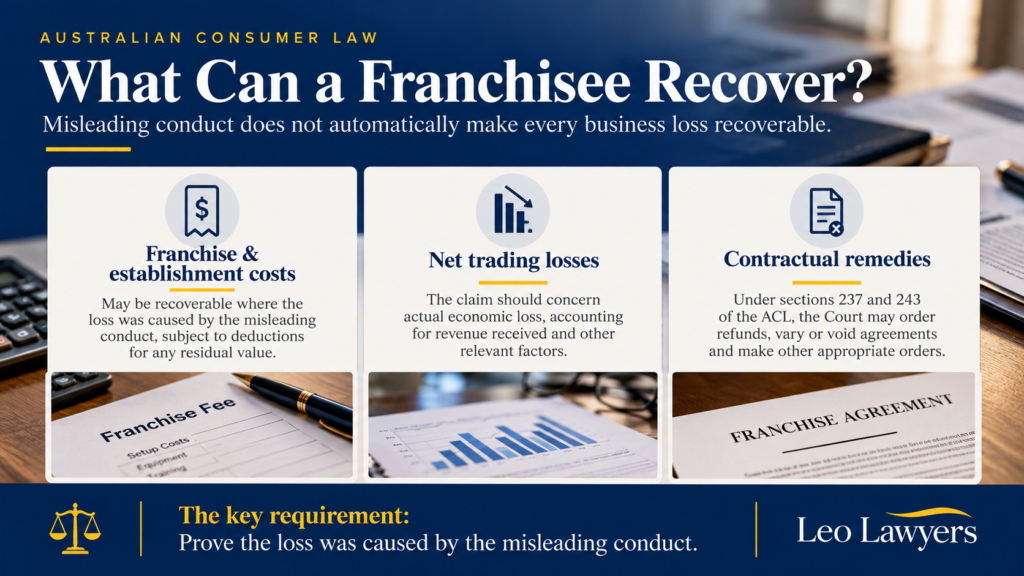
Girchow Enterprises Pty Ltd v Ultimate Franchising Group Pty Ltd [2023] FCA 420 illustrates a reliance-based approach to an unprofitable franchise. The Court addressed the “appropriate quantification of losses where establishment costs [were] expended on setting up unprofitable businesses”. Such expenditure may be recoverable where the claimant proves that it would not have been incurred but for the misleading conduct. However, the recoverable amount must allow for any residual value obtained from equipment, goodwill or other assets.
Trading losses require similar discipline. Revenue received must be credited against expenses, and the claim should ordinarily concern net economic loss rather than anticipated gross income. Financing expenses may also be recoverable where borrowing was undertaken to fund the transaction and was a sufficiently direct consequence of the contravention. In each case, the claimant must address mitigation, intervening events and losses attributable to independent business decisions.
Remedies pursuant to sections 237 and 243 of the ACL
Sections 237 and 243 provide a broader remedial jurisdiction. Section 237 empowers the Court to make orders it considers appropriate to compensate, prevent or reduce loss suffered because of contravening conduct. Section 243 identifies available orders, including declaring a contract void, varying it, refusing enforcement and directing the refund of money.
In Ripani v Century Legend Pty Ltd (No 4) [2024] FCA 1211, the Court emphasised that the words “because of” require a causal nexus between the misleading conduct and the loss: at [47]-[49]. The contravention need not be the sole cause. The Court also accepted that loss may include the detriment of becoming bound by contractual obligations that would not otherwise have been incurred: at [139]-[141].
Statutory rescission is not confined by all the technical requirements of equitable rescission. In Badger v John Kagelaris Pty Ltd [2019] NSWSC 1792, the Court stated that an order declaring a contract void under s 243 is not determined by general-law analogies but by the statutory responsibility imposed by the ACL and an evaluative assessment of the relief necessary to compensate or prevent loss: at [179]. The Court considered restoration of the parties’ positions, the seriousness of the misleading conduct and the practical return of the business before declaring the agreement void: at [180]-[182].
The remedial discretion nevertheless remains compensatory. As recognised in ProLearn v Kytec and Telstra [2022] VSC 5 at [767], broader statutory orders may permit the Court to do more complete justice than damages alone, but relief is not available as of right. A claimant who obtains repayment of a franchise fee cannot also recover damages for the same fee. Likewise, an order voiding the agreement must account for benefits already received.
Conclusion
The proper approach is therefore sequential: identify the contravention, establish the counterfactual, quantify each net loss and select orders that address that loss without duplication. The statutory flexibility is substantial, but it does not relieve the claimant from proving causation or economic disadvantage with precision.
At Leo Lawyers, we understand that disputes involving misleading or deceptive conduct under the Australian Consumer Law can have serious consequences for businesses and consumers alike, often requiring swift, strategic legal action—particularly where liability is alleged to arise from representations, omissions, advertising or pre-contractual communications, and where loss is said to have been suffered in reliance on that conduct.
Whether you are seeking to bring or defend a claim concerning misleading or deceptive conduct under s 18 of the ACL, assess the availability of remedies, or consider limitation and evidentiary issues, feel free to contact Damin Murdock at Leo Lawyers via our website, on (02) 8201 0051 or at office@leolawyers.com.au. Further, if you liked this article, please subscribe to our newsletter via our Website, and subscribe to our YouTube, LinkedIn, Facebook and Instagram. If you liked this article or video, please also give us a favourable Google review.
DISCLAIMER: This is not legal advice and is general information only. You should not rely upon the information contained in this article. If you require specific legal advice, please contact us.

Damin Murdock (J.D | LL.M | BACS - Finance) has over 17 years of experience as a commercial lawyer. He helps businesses navigate construction and technology law. Damin has held several big leadership roles, including serving as a director of a national law firm and the Chief Legal Officer for Lawpath.
He has personally helped more than 2,000 startups and small businesses. With over 300 five-star reviews, his clients clearly value his practical advice and simple way of explaining things. Damin has also hosted over 100 webinars that thousands of people have watched to get reliable legal help.
