
Last Updated on 13/07/2026 by Damin Murdock and Malak Amgad
Following the Federal Court’s decision against Coles regarding its “Down Down” promotion, much of the public discussion focused on supermarket discounts and grocery prices. This makes sense because the decision concerns everyday products and almost every household.
However, in our view, the Coles proceedings highlight a broader regulatory trend that should concern businesses across Australia. The case falls within the increasing scrutiny of the Australian Competition and Consumer Commission (ACCC), not only on individual representations made to consumers but also on the systems, pricing structures, marketing practices, and business processes that affect consumers.
Businesses should pay attention because most consumer law disputes do not arise because of an intentional misrepresentation, but because pricing models, online content, marketing or sales processes create a false expectation that eventually isn’t met.
The decision against Coles
The proceedings arose from allegations by the ACCC that Coles had engaged in misleading conduct through aspects of its “Down Down” promotional campaign.
On 14 May 2026, the Federal Court handed down its decision that Coles had engaged in misleading conduct in relation to certain pricing strategies. The Court accepted the ACCC’s allegations that, in some instances, Coles increased product prices before later reducing them and promoting them as discounted, creating the impression that consumers were receiving a genuine saving when that was not necessarily the case.
The case attracted significant public attention because it concerned everyday consumer purchases and affected many households in Australia. This crackdown on misleading pricing strategies applies beyond the supermarket shelves.
Consumer law disputes are increasingly about systems
One of the most important lessons from recent ACCC enforcement activity is that regulatory scrutiny is no longer limited to isolated statements or individual acts of misconduct.
Increasingly, regulators are examining the systems that produce those representations.
Pricing algorithms, automated discount campaigns, dynamic pricing, website content, subscription models, price comparison tools, customer communications and sales processes could all pose legal risk to businesses, especially those operating at scale. This applies equally to large corporations, family businesses, e-commerce stores, professional service providers, builders, developers and startups.
The Coles proceedings demonstrate how ordinary business systems can become the focus of major consumer law litigation.
The broader ACCC enforcement trend
The Coles proceedings sit within a much larger enforcement pattern.
Recent high-profile ACCC matters have involved Qantas, Optus, Volkswagen and others. Although these cases arose in different industries, they share a common feature: the alleged conduct affected large numbers of consumers.
In the Qantas proceedings, the ACCC challenged representations made to consumers concerning cancelled flights. In the Optus matter, the regulator pursued allegations relating to sales practices affecting vulnerable consumers. The Volkswagen litigation concerned emissions representations. The facts differed significantly from case to case.
However, the ACCC’s approach reveals a common theme. The regulator appears increasingly willing to pursue large-scale enforcement action where conduct is alleged to have created widespread consumer harm. But businesses should not assume that these cases are relevant only to major corporations. The legal principles being applied are the same principles that govern how all Australian businesses interact with consumers.
Consumer law compliance is increasingly becoming a governance issue
Historically, many businesses viewed consumer law compliance as a marketing issue. These recent decisions, however, suggest that consumer law compliance is now being treated as a governance issue. Pricing practices, advertising campaigns, customer communications, website content and sales processes can all create legal exposure if they’re not properly reviewed.
For businesses, this means consumer law risk should be considered before a campaign is launched rather than after a complaint is received.
The cost of preventative legal review is often significantly lower than the cost of defending regulatory investigations, responding to ACCC enquiries or managing litigation.
The real lesson from the Coles decision
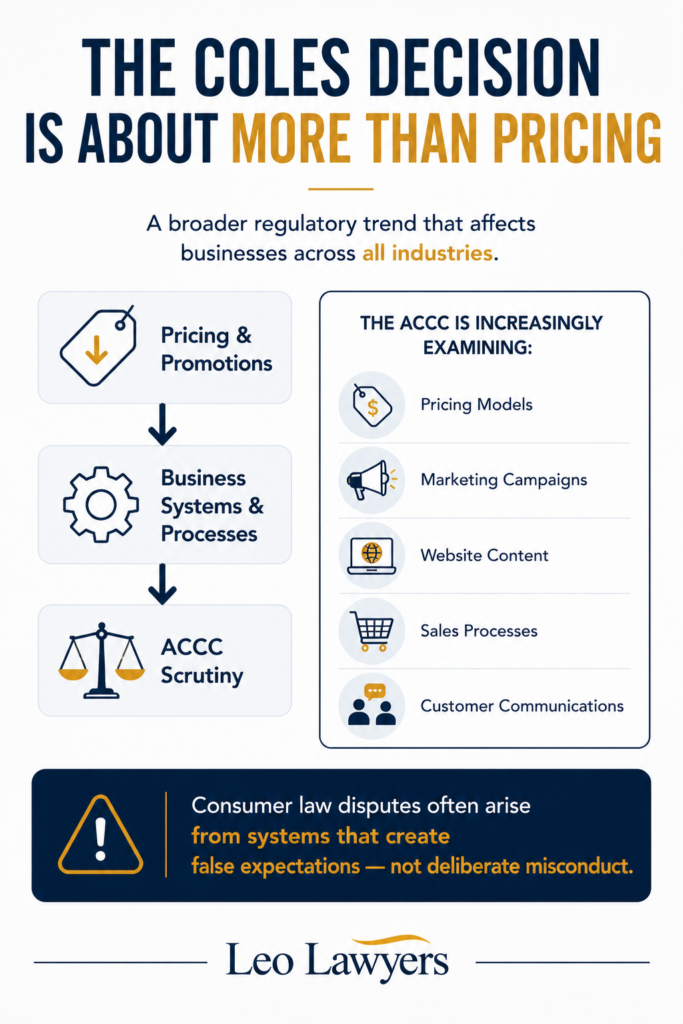
The real lesson from the Coles proceedings is that regulators are more focused on how businesses interact with consumers, and whether they implement systems that systematically mislead consumers.
The ACCC’s recent actions suggest that consumer law compliance is becoming an increasingly important area of regulatory risk for Australian businesses.
Australian businesses should not assume that they are safe from scrutiny because they’re a medium or small enterprise. Consumer Law applies regardless of the business size. Mistakes could be very costly, especially for smaller businesses.
This is why we recommend proactive review of all consumer-facing practices to circumvent legal risk.
Need expert legal advice? Feel free to contact Damin Murdock at Leo Lawyers via our website, on (02) 8201 0051 or at office@leolawyers.com.au. Further, if you liked this article, please subscribe to our newsletter via our Website, and subscribe to our YouTube, LinkedIn, Facebook and Instagram. If you liked this article or video, please also give us a favourable Google review.
DISCLAIMER: This article is not to be taken as legal advice and is general in nature. If you require specific advice, please contact us.

Damin Murdock (J.D | LL.M | BACS - Finance) has over 17 years of experience as a commercial lawyer. He helps businesses navigate construction and technology law. Damin has held several big leadership roles, including serving as a director of a national law firm and the Chief Legal Officer for Lawpath.
He has personally helped more than 2,000 startups and small businesses. With over 300 five-star reviews, his clients clearly value his practical advice and simple way of explaining things. Damin has also hosted over 100 webinars that thousands of people have watched to get reliable legal help.

