
Last Updated on 02/09/2026 by Damin Murdock and Nohra Chalouhi
Start-ups and closely held proprietary companies often need to issue shares quickly, whether to bring in investors, restructure founder holdings or incentivise employees. However, those decisions are commonly constrained by pre-emptive rights, which give existing shareholders an opportunity to participate in certain issues of shares or other securities (such as SAFEs, Convertible Notes and options). This article examines how statutory pre-emptive rights operate under the Corporations Act 2001 (Cth), the policy reasons for those protections, and why it is important to understand the precise scope of the relevant restriction before a company proceeds with a proposed issue.
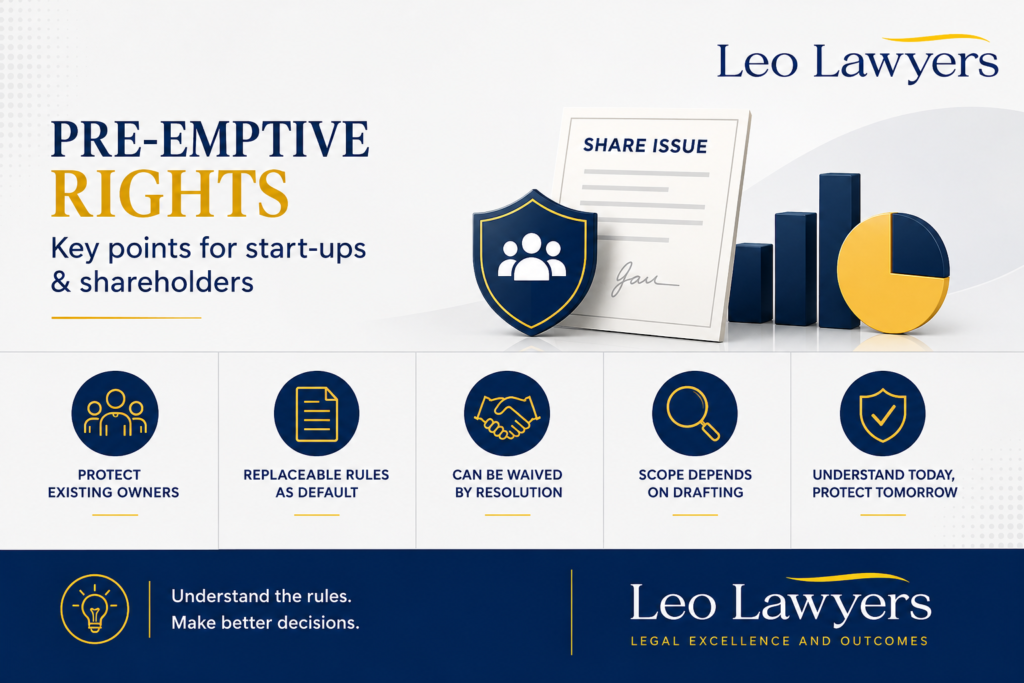
Replaceable rules as default governance terms
The replaceable rules of the Corporations Act 2001 (Cth) (the Act) are best understood as statutory default terms for company governance. A proprietary company that elects to use the replaceable rules to govern its affairs technically does not need a constitution of its own. That said, as their name suggests, the replaceable rules can be displaced or modified by a constitution tailored to the company.
The replaceable rules cover aspects of a company’s operation, including the conduct of directors’ and shareholders’ meetings, voting procedures and, as relevant for this article, restrictions on a company’s ability to issue shares. While a contravention of the replaceable rules does not itself constitute a breach of the Act, section 135 recognises their role as part of the company’s internal management framework, giving them contractual force as between a company, its directors and its members.
Section 254D: pre-emptive rights on the issue of shares
Section 254D of the Act provides the replaceable rule on pre-emption for existing shareholders on the issue of shares in a proprietary company. It is not uncommon for the mechanism of this rule, and even its exact wording in some instances, to be adopted in company constitutions and shareholders agreements.
The rule operates as a valuable safeguard against dilution of a company’s shareholding. It requires a proposed issue of shares to be offered first to existing holders of the relevant class, as far as practicable in proportion to their existing holdings. This gives existing shareholders the opportunity to preserve their economic percentage and voting influence before the company admits new equity.
Waiving pre-emptive rights
Notably, the final subsection of s 254D provides an important caveat: shareholders can choose to waive their statutory pre-emptive rights. Under s 254D(4), a company may pass a resolution at a general meeting authorising the directors to make a particular issue of shares without complying with s 254D(1).
Because such a waiver may lead to dilution of shareholders’ economic and voting interest, shareholders should be fully informed about the proposed issue of shares. It is also good practice for the consent to be documented by a signed written waiver supporting the resolution. A written waiver should cover key details such as confirmation that the shareholders have received sufficient information, confirmation that the waiver applies only to that particular issue, and the source of the right being waived – s 254D, the constitution, shareholders agreement or all of them.
Understanding the scope of pre-emptive rights
It is important to consider how a constitution or shareholders agreement may expand or reduce the ordinary scope of the statutory rule. In Lion Nathan Australia Pty Ltd v Coopers Brewery Ltd [2005] FCA 1812, the Court considered a pre-emptive rights regime that was drafted in terms directed to transfers between shareholders. Share buy-backs involving the company and its shareholders, which did not trigger the regime’s precise intention to restrict the introduction of new members into the company, did not fall within the regime’s scope of operation. The case illustrates that the scope of pre-emptive rights depends closely on the words used in the relevant constitution or shareholders agreement.
For that reason, it should always be queried whether a particular instrument is caught by the relevant pre-emptive rights regime. For example, a SAFE is an agreement for future equity rather than an immediate issue of shares. Whether a SAFE is restricted by pre-emptive rights will therefore depend on whether the relevant drafting applies only to shares, or extends to broader categories such as ‘securities’, equity securities or rights to acquire shares.
Need Advice?
At Leo Lawyers, we understand that share issues can be critical to a company’s growth, but mismanaging pre-emptive rights can create unnecessary disputes, delay investment and expose decisions to challenge. For founders and directors, the priority is often to move quickly and secure the company’s next stage of growth; for shareholders, the equally legitimate concern is protecting their ownership, voting power and bargain against unexpected dilution.
Whether you are a director or shareholder, feel free to contact Damin Murdock at Leo Lawyers via our Website, on (02) 8201 0051 or at office@leolawyers.com.au. Further, if you liked this article, please subscribe to our newsletter via our Website, to our YouTube, LinkedIn, Facebook and Instagram, and kindly give us a favourable Google Review.
DISCLAIMER: This is not legal advice and is general information only. You should not rely upon the information contained in this article and if you require specific legal advice, please contact us

Damin Murdock (J.D | LL.M | BACS - Finance) has over 17 years of experience as a commercial lawyer. He helps businesses navigate construction and technology law. Damin has held several big leadership roles, including serving as a director of a national law firm and the Chief Legal Officer for Lawpath.
He has personally helped more than 2,000 startups and small businesses. With over 300 five-star reviews, his clients clearly value his practical advice and simple way of explaining things. Damin has also hosted over 100 webinars that thousands of people have watched to get reliable legal help.
