
Last Updated on 13/07/2026 by Damin Murdock and Nohra Chalouhi
The broad body of judicial decisions in construction disputes points to one undeniable truth: when it comes to contracts, the devil is in the details. A clause that appears benign at the outset can, if tested in litigation, produce unexpectedly harsh and costly consequences. For that reason, it is crucial to identify, assess and, where necessary, renegotiate potential contractual traps before the agreement is signed.
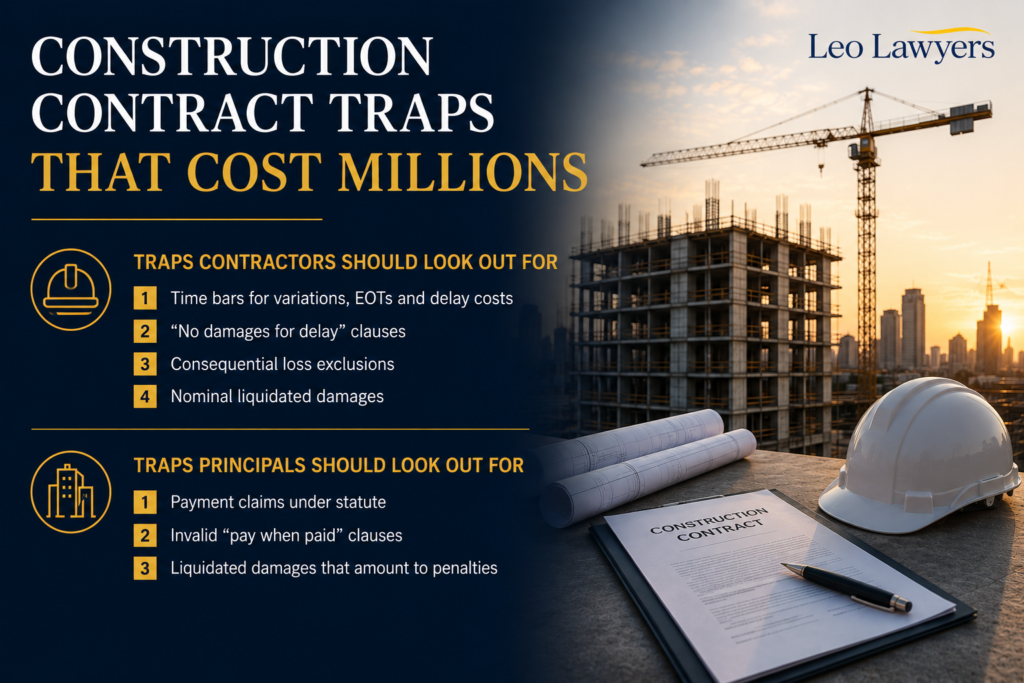
Traps contractors should look out for
-
Time bars for variations, EOTs and delay costs
A contractor may have a genuine claim, but lose it by missing a contractual notice deadline. Courts have generally required strict compliance with time bars and the procedures set out therein.
The Court in CMA Assets Pty Ltd v John Holland Pty Ltd [No 6] [2015] WASC 217 acknowledged the harshness of situations where a perfectly meritorious claim is defeated by a time bar, but stressed that such provisions are treated inflexibly in their application. Contractors should diarise notice requirements from day one and issue protective notices early.
-
“No damages for delay” clauses
Contractors are not always at fault for delays and should therefore be careful to ensure that costs are recoverable for such delays.
In Lucas Earthmovers Pty Ltd v Anglogold Ashanti Australia Ltd [2019] FCA 1049, the contractor’s time-related costs claim failed where the contract expressly excluded claims for losses, costs and expenses resulting from delay or disruption. A construction of the contract as a whole in that case revealed that the only prescribed remedy for “any” such scenarios was EOTs.
-
Consequential loss exclusions
Broad exclusions of liability for loss under a contract can bar your entitlement to otherwise valuable claims. Contractors must be cautious before assuming that a Principal’s actions, such as repudiation, will automatically entitle them to recovering losses incurred as a result.
The Court in Macmahon Mining Services v Cobar Management [2014] NSWSC 502 construed an exclusion of liability for “loss of contract” broadly, stating that it covered even loss of other third party contracts, as well as loss as a consequence of the Principal’s repudiation.
-
Nominal Liquidated Damages
Nominal liquidated damages may not protect contractors from larger claims for delay at Court.
In Cappello v Hammond & Simonds NSW Pty Ltd [2020] NSWSC 1021 and Carbone v Fowler Homes Pty Ltd [2024] NSWCA 192, Courts treated very low liquidated damages clauses cautiously, holding that by comparing these damages to the overall contract price, it could not be inferred that the parties intended for the principal to be limited to mere nominal damages. Clear drafting is essential if liquidated damages are intended to be the exclusive remedy for delay.
Traps principals should look out for
-
Payment claims under statute
A principal should not assume that the contract alone provides the only means for a contractor to serve and be entitled to a payment claim. In Walter Construction Group Ltd v CPL (Surry Hills) Pty Ltd [2003] NSWSC 266, the Court held that it is not necessary for a contractor to establish entitlement under the contract before having recourse to their entitlement and to the appropriate procedures set out under statutes such as the Building and Construction Industry Security of Payment Act 1999 (NSW).
All that being said, a contractor would have to ensure that the claim is unambiguously compliant with the particular requirements of the relevant Act.
-
Invalid “pay when paid” clauses
Imprudent attempts to contractually pass payment risk down the chain are likely to fail, as statute commonly stands in the way of “pay when paid” provisions.
In Maxcon Constructions Pty Ltd v Vadasz [2018] HCA 5, the Court held that a retention provision linked to head-contract events such as the provision of a certificate of occupancy, itself tied to certification by the head contractor, was to be treated as a prohibited “pay when paid” provision.
-
Liquidated damages that amount to penalties
Principals may understandably seek to mitigate their losses against defaults by a contractor, and LD clauses are a common way to do so.
However, as affirmed by cases such as Spiers Earthworks Pty Ltd v Landtec Projects Corp Pty Ltd (No 2) [2013] WASCA 53, if the damages cannot be characterised as a genuine pre-estimate of damage pursuant to default, then the clause is liable to be treated as an ineffective penalty.
Need Advice?
At Leo Lawyers, we understand that canvassing all the potential shortfalls of a construction contract is meticulous work. A well-negotiated and clear agreement saves all parties a lot of trouble down the line.
Feel free to contact Damin Murdock at Leo Lawyers via our website, on (02) 8201 0051 or at office@leolawyers.com.au. Further, if you liked this article, please subscribe to our newsletter via our Website, to our YouTube, LinkedIn, Facebook and Instagram, and kindly give us a favourable Google Review.
DISCLAIMER: This is not legal advice and is general information only. You should not rely upon the information contained in this article and if you require specific legal advice, please contact us.

Damin Murdock (J.D | LL.M | BACS - Finance) has over 17 years of experience as a commercial lawyer. He helps businesses navigate construction and technology law. Damin has held several big leadership roles, including serving as a director of a national law firm and the Chief Legal Officer for Lawpath.
He has personally helped more than 2,000 startups and small businesses. With over 300 five-star reviews, his clients clearly value his practical advice and simple way of explaining things. Damin has also hosted over 100 webinars that thousands of people have watched to get reliable legal help.

