
Last Updated on 17/03/2026 by Damin Murdock
As strata schemes evolve, lot owners often seek to make improvements to common property, such as installing decks, pergolas, or enclosing courtyards. These alterations raise important questions about insurance, liability, and maintenance. One common query is whether a strata by-law can require a lot owner to obtain insurance as a condition of being granted approval for those works.
The short answer is yes, but only in specific circumstances, and only when the by-law complies with the requirements of the Strata Schemes Management Act 2015 (NSW) (the Act).
When Can a By-law Require an Owner to Take Out Insurance?
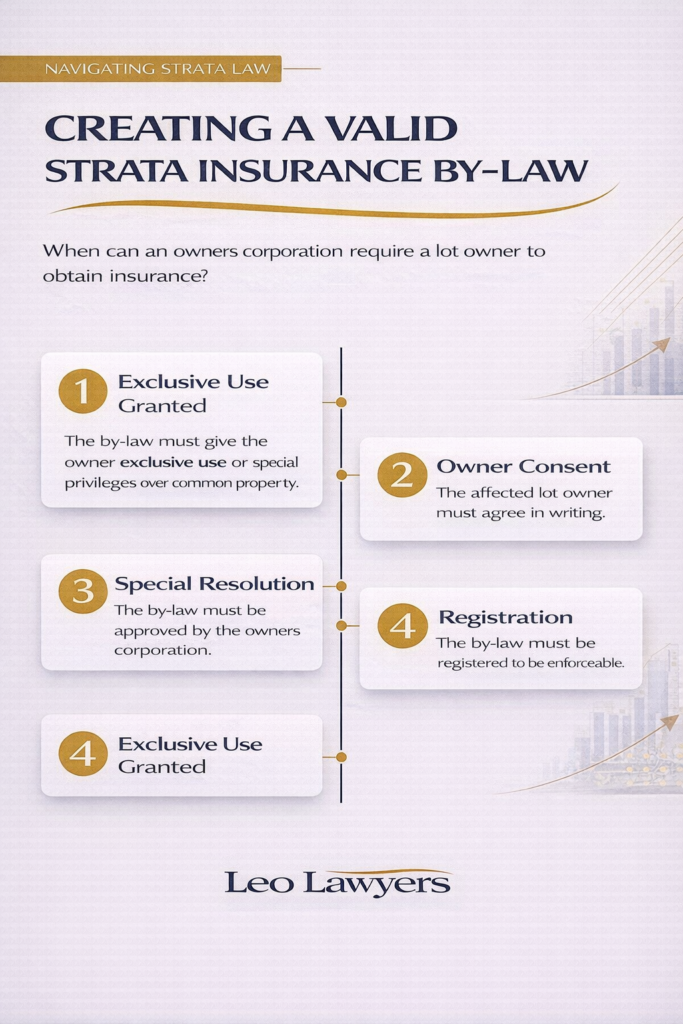
A by-law can lawfully require a lot owner to take out insurance or pay for maintenance, but only where it forms part of a common property rights by-law that grants the owner exclusive use or special privileges over part of the common property. These by-laws are governed by the Act and must meet strict procedural and content-based requirements, including:
- The by-law must be passed by special resolution;
- The affected owner must consent in writing; and
- The by-law must be registered.
As established in The Owners – Strata Plan No 50276 v Thoo and Sahin v The Owners – Strata Plan No 30902, a by-law can include financial obligations such as requiring an owner to pay for maintenance or insurance, but only when it is tied to exclusive rights to use or special privileges over common property, and the statutory requirements are strictly observed.
Legal Limits on Imposing Insurance Obligations
Strata by-laws cannot impose insurance or financial obligations on lot owners arbitrarily. Any such obligation must relate to the maintenance, repair, or protection of common property that is subject to exclusive use or alterations by the lot owner. Importantly:
- The obligation must be reasonable and relevant to the specific works or rights approved;
- The by-law must clearly set out what type of insurance is required and under what conditions; and
- The owners corporation cannot use a by-law to override or contract out of provisions in the Act.
In Owners Corporation SP 32033 v Mullins [2015] NSWCATCD 23, the Tribunal clarified that obligations imposed through by-laws must be properly authorised and linked to the legal mechanism of a common property rights by-law, and must comply with the procedural and substantive requirements of the Act. For instance, in this case it was held by the Tribunal that a resolution that transfers responsibility for maintaining common property to a lot owner without giving the lot owners exclusive use of or special privileges over the common property is not permitted. Further, it was held that the proposed by-law was invalid.
What Should a Valid By-law Include?
For a by-law to validly require insurance, it should:
- Specify the nature of the alteration (e.g. structure, fencing, enclosure).
- Define the insurance requirements (e.g. type, value, and coverage period).
- State consequences for non-compliance.
- Reflect the written consent of the lot owner.
- Be properly passed and registered.
Without these elements, the by-law may be invalid or unenforceable.
Key Considerations for Owners Corporations
Before adopting a by-law that compels or requires insurance:
- Ensure the works fall within the scope of a common property rights by-law.
- Confirm the owner agrees to the financial and insurance conditions in writing.
- Carefully draft the by-law to reflect the specific risks and responsibilities involved.
- Outline the exclusive use or special privileges being granted.
- Register the by-law promptly following the special resolution.
Failing to follow these steps may expose the owners corporation to legal challenges or liability disputes.
Conclusion
A strata by-law can require an owner to take out insurance for alterations to common property, but only if it forms part of a properly made common property rights by-law. The by-law must be linked to the granting of exclusive use or special privileges, passed by special resolution, and supported by the written consent of the owner. Careful drafting is essential to ensure the by-law is valid, enforceable, and compliant with the Act.
Feel free to contact Damin Murdock at Leo Lawyers via our website, on (02) 8201 0051 or at office@leolawyers.com.au. Further, if you liked this article, please subscribe to our newsletter via our Website, and subscribe to our YouTube , LinkedIn, Facebook and Instagram. If you liked this article or video, please also give us a favourable Google Review.
DISCLAIMER: This is not legal advice and is general information only. You should not rely upon the information contained in this article and if you require specific legal advice, please contact us.

Damin Murdock (J.D | LL.M | BACS - Finance) is a seasoned commercial lawyer with over 17 years of experience, recognised as a trusted legal advisor and courtroom advocate who has built a formidable reputation for delivering strategic legal solutions across corporate, commercial, construction, and technology law. He has held senior leadership positions, including director of a national Australian law firm, principal lawyer of MurdockCheng Legal Practice, and Chief Legal Officer of Lawpath, Australia's largest legal technology platform. Throughout his career, Damin has personally advised more than 2,000 startups and SMEs, earning over 300 five-star reviews from satisfied clients who value his clear communication, commercial pragmatism, and in-depth legal knowledge. As an established legal thought leader, he has hosted over 100 webinars and legal videos that have attracted tens of thousands of views, reinforcing his trusted authority in both legal and business communities."
