
Last Updated on 22/07/2026 by Damin Murdock and Malak Amgad
The Fair Work Legislation Amendment (Closing Loopholes) Act 2023 and the Fair Work Legislation Amendment (Closing Loopholes No. 2) Act 2024 fundamentally change how businesses manage casuals, independent contractors, and gig workers and set new limits for off-hour communications. At Leo Lawyers, we’ve prepared this guide to help you navigate these new changes.
The Right to Disconnect
One of the most discussed aspects of the Closing Loopholes No. 2 Act is the worker’s statutory right to disconnect. Under this rule, employees are legally entitled to refuse to monitor, read, or respond to contact or attempted contact from their employers or third parties related to work outside of their working hours, unless that refusal is deemed unreasonable.
What makes a refusal unreasonable?
The Fair Work Commission (FWC) examines the urgency of the communication, the employee’s level of responsibility and compensation, the employee’s personal circumstances like family or caring responsibilities, and whether the employee is being compensated for being on-call or for additional working hours.
The Closing Loopholes No.2 Act took effect for standard businesses on August 26 2024, and for small businesses of under 15 employees on 26 August 2025.
Redefining Casual Employment and Casual Conversion
The amendments change the legal definition of casual employee, shifting from relying on the text of the contract to examining the practical reality of the working relationship. Under the new rules, an employee is only considered casual if there is no firm advance commitment to continuing and indefinite work according to an agreed pattern, and if the employee is entitled to casual loading.
The “Employee Choice” Pathway
Previously, employers had to offer casual conversion proactively. This system has now been replaced by the Employee Choice Pathway, which dictates that:
- Employees in non-small businesses can request to convert to permanent employment after 6 months of regular work.
- Employees in small businesses can request conversion after 12 months.
- Employers can only reject the conversion due to fair and reasonable business grounds. For example, if the role will no longer exist, if there will be drastic changes to the hours worked, if there’s a structural change to the business, and so on.
Once an employee converts to permanent status, they become eligible for the full range of paid leave entitlements that casual employees do not accrue.
Employee v Independent Contractor
The amendments mandate evaluating the substance, practical reality, and true nature of employment instead of just the contract when deciding whether a worker is an employee or an independent contractor.
Protections for Gig Workers
For the first time, the FWC has the power to set minimum standards for pay rates, insurance and dispute resolution for two classes of independent contractors: digital platform workers such as rideshare and food delivery drivers, and road transport contractors.
The criminalisation of intentional wage theft
The Closing Loopholes framework criminalised intentional wage theft under federal law. Employers who intentionally underpay their workers’ wages, superannuation, or other entitlements could face severe criminal penalties. These penalties can go up to $4.69 million for corporates, while individuals face up to 10 years in prison and heavy personal fines. The Small Business Wage Compliance Code is available to protect small businesses from criminal prosecution, under the condition that they proactively rectify their compliance issues.
Same Job, Same Pay
If a business brings in labour-hire workers to do the same job as internal employees, the FWC can issue Regulated Labour Hire Arrangement Orders to force the business to pay these workers at least the same rate as their enterprise agreement dictates.
Strengthened Workplace Delegates’ Rights
Union and workplace delegates received substantial new statutory protections. Employers must provide delegates with reasonable time, facilities and paid leave for training to communicate with and represent union members.
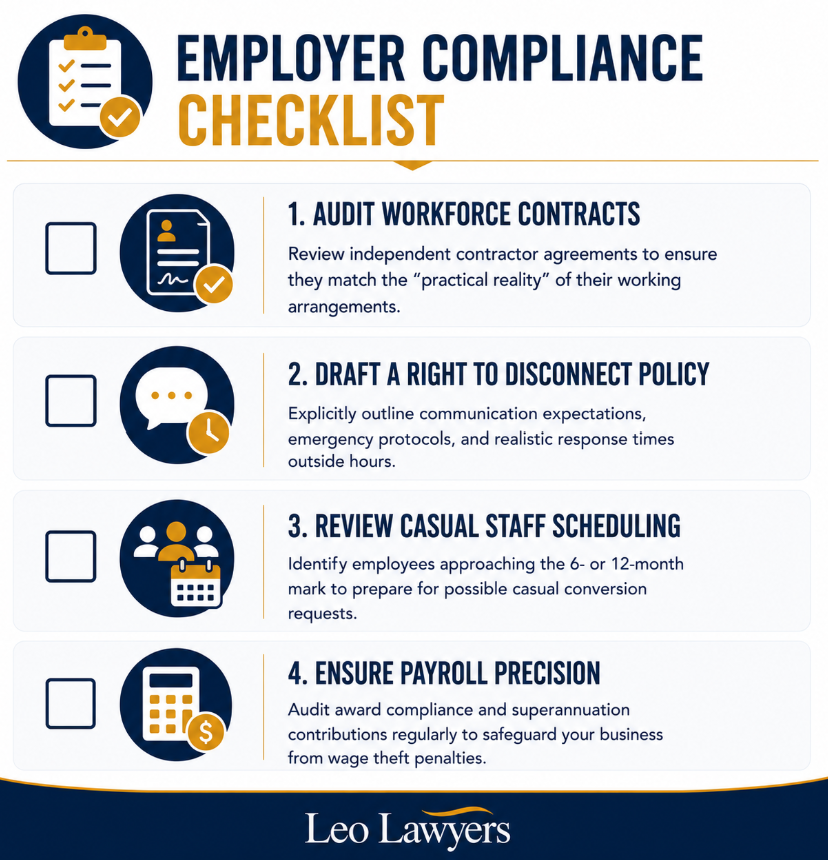
Checklist for business compliance
At Leo Lawyers, we’ve prepared this checklist to help your business remain compliant with the evolving Fair Work laws:
If you have any questions about the recent amendments or need legal advice, feel free to contact Damin Murdock at Leo Lawyers via our website, on (02) 8201 0051 or at office@leolawyers.com.au. Further, if you liked this article, please subscribe to our newsletter via our Website, and subscribe to our YouTube, LinkedIn, Facebook and Instagram. If you liked this article or video, please also give us a favourable Google Review.
DISCLAIMER: This is not legal advice and is general information only. You should not rely upon the information contained in this article, and if you require specific legal advice, please contact us.

Damin Murdock (J.D | LL.M | BACS - Finance) has over 17 years of experience as a commercial lawyer. He helps businesses navigate construction and technology law. Damin has held several big leadership roles, including serving as a director of a national law firm and the Chief Legal Officer for Lawpath.
He has personally helped more than 2,000 startups and small businesses. With over 300 five-star reviews, his clients clearly value his practical advice and simple way of explaining things. Damin has also hosted over 100 webinars that thousands of people have watched to get reliable legal help.

