
Last Updated on 13/07/2026 by Damin Murdock and Nohra Chalouhi
One of the fundamental duties imposed on company directors is to prevent a company from incurring debts while insolvent. Although incorporation ordinarily protects directors from personal liability, that protection may be lost where a director permits insolvent trading, potentially exposing them to compensation claims, civil penalties and, in serious cases, criminal liability.
When Does Insolvent Trading Occur?
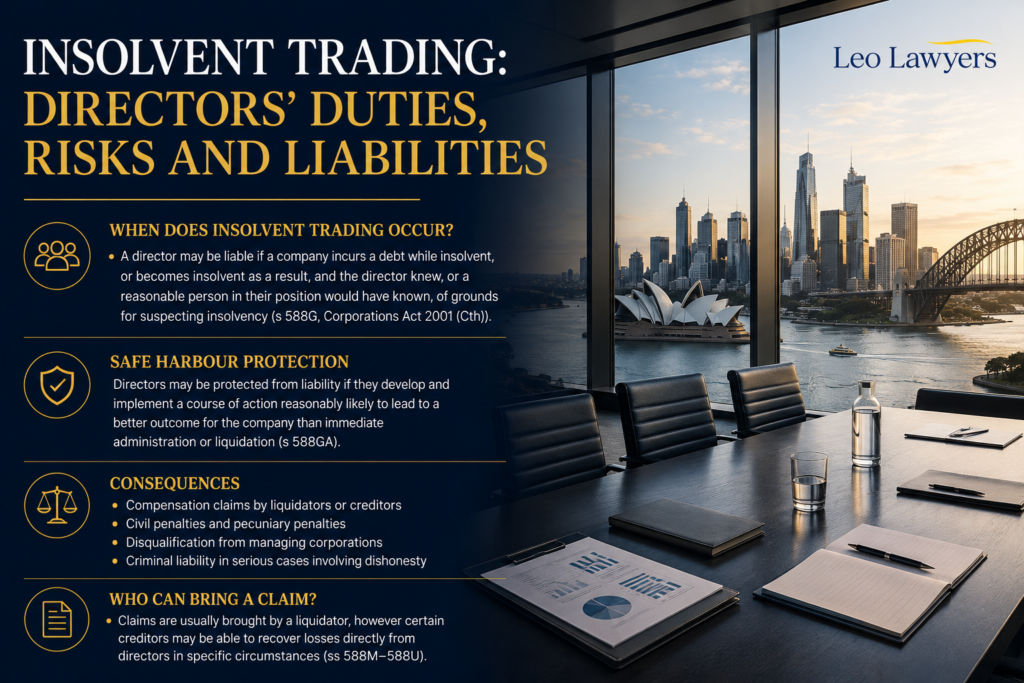
Under section 588G of the Corporations Act 2001 (Cth), a director may be liable where a company incurs a debt while insolvent, or becomes insolvent by incurring that debt, and the director knew, or a reasonable person in their position would have known, of grounds for suspecting insolvency. In Hall v Poolman [2009] NSWCA 64, the Court observed that such a suspicion of insolvency falls somewhere between a positive belief and mere speculation, highlighting that directors cannot simply ignore signs of financial distress.
Section 95A of the Corporations Act defines insolvency as the inability to pay debts as and when they fall due. The High Court interpreted some leniency into that definition in Sandell v Porter [1966] HCA 28, clarifying that insolvency should be assessed by reference to a company’s financial position as a whole and not merely by a temporary lack of liquidity. Accordingly, a company’s ability to pay debts is not confined to cash on hand, but may include funds that can be raised by realising or borrowing against assets within a relatively short period.
Courts commonly assess insolvency by reference to the indicators identified in ASIC v Plymin [2003] VSC 123, including continuing trading losses, overdue taxes, unpaid creditors, dishonoured payments, an inability to obtain finance and poor financial records. These warning signs are often relied upon to establish that a director should have suspected insolvency.
The Corporations Act nevertheless recognises that directors should be able to pursue genuine restructuring efforts. Section 588GA provides a “safe harbour” from insolvent trading liability where directors develop and implement a course of action reasonably likely to lead to a better outcome for the company than immediate administration or liquidation.
What Are the Consequences?
A director who breaches section 588G may face significant personal consequences. These include compensation claims for losses caused by insolvent trading, civil penalty proceedings, pecuniary penalties and disqualification from managing corporations. In serious cases involving dishonesty, criminal liability may also arise.
Who Can Bring a Claim?
In most cases, insolvent trading claims are pursued by a liquidator for the benefit of creditors as a whole. However, section 588M also provides a mechanism through which an individual creditor may recover losses directly from a director where the creditor has suffered loss because of the company’s insolvency and the company is being wound up.
Creditors will ordinarily require the liquidator’s consent under section 588R. If consent is not forthcoming, sections 588S and 588T permit a creditor, after giving the required written notice, to seek leave from the Court to commence proceedings directly. In Dean v My Solicitors Pty Ltd (in liquidation), the Federal Court granted leave where the statutory requirements were satisfied and no prejudice to other creditors was identified.
However, section 588U prevents creditors from pursuing claims where the liquidator has already taken certain recovery or enforcement steps in relation to the same conduct.
Need Advice?
At Leo Lawyers, we understand the seriousness of misnavigating insolvency risks and the potential hazards therein. As a director, your concern is with keeping your prized business afloat through hardship; and as a creditor, your equally righteous concern is being able to recover a just share of the money you are owed.
Whether you are one or the other, feel free to contact Damin Murdock at Leo Lawyers via our website, on (02) 8201 0051 or at office@leolawyers.com.au. Further, if you liked this article, please subscribe to our newsletter via our Website, to our YouTube, LinkedIn, Facebook and Instagram, and kindly give us a favourable Google Review.
DISCLAIMER: This is not legal advice and is general information only. You should not rely upon the information contained in this article and if you require specific legal advice, please contact us

Damin Murdock (J.D | LL.M | BACS - Finance) has over 17 years of experience as a commercial lawyer. He helps businesses navigate construction and technology law. Damin has held several big leadership roles, including serving as a director of a national law firm and the Chief Legal Officer for Lawpath.
He has personally helped more than 2,000 startups and small businesses. With over 300 five-star reviews, his clients clearly value his practical advice and simple way of explaining things. Damin has also hosted over 100 webinars that thousands of people have watched to get reliable legal help.

