
Last Updated on 26/03/2026 by Damin Murdock
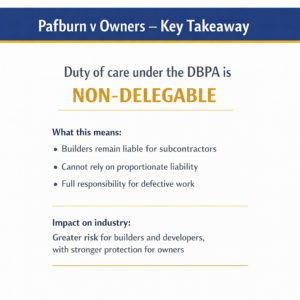
The High Court’s decision in Pafburn Pty Ltd v the Owners – Strata Plan No 84674 marks one of the most significant developments in construction law since the introduction of the Design and Building Practitioners Act 2020 (NSW) (the DBPA). The ruling confirms that the statutory duty of care under s 37 of the DBPA is non-delegable, fundamentally reshaping how builders, developers and construction professionals manage risk.
Background to the Dispute
The Owners Corporation of Strata Plan No 84674 commenced proceedings against:
- Madarina Pty Ltd (the Developer); and
- Pafburn Pty Ltd (the Builder).
The claim alleged breaches of the statutory duty of care under s 37 of the DBPA, arising from major building defects that caused significant economic loss.
In response, the Developer and Builder sought to rely on Part 4 of the Civil Liability Act 2002 (NSW) (the CLA), which ordinarily allows liability to be apportioned among multiple wrongdoers and in this case the subcontractors who performed parts of the construction work.
Key Legislative Framework
Design and Building Practitioners Act 2020 (NSW)
Section 37 imposes a statutory duty of care on anyone carrying out “construction work”. This duty requires practitioners to take reasonable care to avoid economic loss caused by defects. Importantly, the duty:
- Applies retrospectively;
- Extends to developers, builders, designers and supervisors; and
- Protects current and future owners.
Civil Liability Act 2002 (NSW)
Two parts of the CLA were applicable to this dispute:
Part 4 – Proportionate Liability (ss 34-39)
Allows liability to be apportioned among multiple wrongdoers where a claim is “apportionable” which can reduce a defendant’s share of damages.
Section 5Q – Liability for Independent Contractors
Provides that where a person owes a non-delegable duty of care, they are liable for the negligence of independent contractors performing work on their behalf.
What the High Court Decided
The High Court dismissed the appeal and held that:
- The duty of care under s 37 of the DBPA is non-delegable
This means a person who owes the duty cannot avoid liability by arguing that subcontractors or external trades were responsible for the defective work.
- Section 5Q of the CLA applies
The Court found that s 5Q of the CLA creates a form of vicarious liability for work entrusted to others. If a builder or developer owes a statutory duty of care, they remain responsible for the acts or omissions of subcontractors.
- Proportionate liability under Part 4 of the CLA does not apply
Because the duty is non-delegable, the claim is not an “apportionable claim”. Builders and developers cannot reduce their liability by pointing to subcontractors as concurrent wrongdoers.
For instance, where an owner claims against the builder, the builder cannot reduce the claim brought by the owner by claiming that a third party performed those works. Instead, if the builder is found liable, then full judgment will be entered against the builder in favour of the owner, and then possibly the builder will obtain a judgment against its third party subcontractor, but ultimately, the builder will be responsible to remedy or pay for the defective or incomplete works, even if those works were performed by a third party.
Why This Decision Matters for the Building Industry
The High Court’s ruling in Pafburn Pty Ltd v The Owners has significant consequences for everyone involved in construction projects. By confirming that the statutory duty of care under s 37 of the DBPA is non-delegable, the Court has reshaped how risk is managed across the industry.
- Greater Liability Exposure for Builders and Developers
Parties responsible for carrying out or supervising construction work now bear full responsibility for ensuring the work is performed with reasonable care even where subcontractors or external trades are involved in the construction. Liability can no longer be diluted by pointing to others involved in the work.
- Contractual Risk Allocation Becomes More Important
With proportionate liability unavailable, builders and developers will need review their contractual frameworks to manage their exposure.
- Enhanced Protection for Owners
The decision reinforces the consumer protection purpose of the DBPA with a clearer pathway to rectify defects without the complexity of having to identify and pursue multiple subcontractors.
- Increased Need for Subcontractor Oversight
Builders can no longer rely on proportionate liability to shift responsibility and effective communication and quality insurance process will be crucial to reducing the risk of claims.
Conclusion
The High Court’s decision in Pafburn confirms that the statutory duty of care under the DBPA is a non-delegable obligation. Builders, developers and construction professionals must take full responsibility for the quality of all work performed on a project, regardless of who physically carries it out.
Feel free to contact Damin Murdock at Leo Lawyers via our website, on (02) 8201 0051 or at office@leolawyers.com.au. Further, if you liked this article, please subscribe to our newsletter via our Website, and subscribe to our YouTube, LinkedIn, Facebook and Instagram. If you liked this article or video, please also give us a favourable Google Review.
DISCLAIMER: This is not legal advice and is general information only. You should not rely upon the information contained in this article and if you require specific legal advice, please contact us.

Damin Murdock (J.D | LL.M | BACS - Finance) is a seasoned commercial lawyer with over 17 years of experience, recognised as a trusted legal advisor and courtroom advocate who has built a formidable reputation for delivering strategic legal solutions across corporate, commercial, construction, and technology law. He has held senior leadership positions, including director of a national Australian law firm, principal lawyer of MurdockCheng Legal Practice, and Chief Legal Officer of Lawpath, Australia's largest legal technology platform. Throughout his career, Damin has personally advised more than 2,000 startups and SMEs, earning over 300 five-star reviews from satisfied clients who value his clear communication, commercial pragmatism, and in-depth legal knowledge. As an established legal thought leader, he has hosted over 100 webinars and legal videos that have attracted tens of thousands of views, reinforcing his trusted authority in both legal and business communities."
