
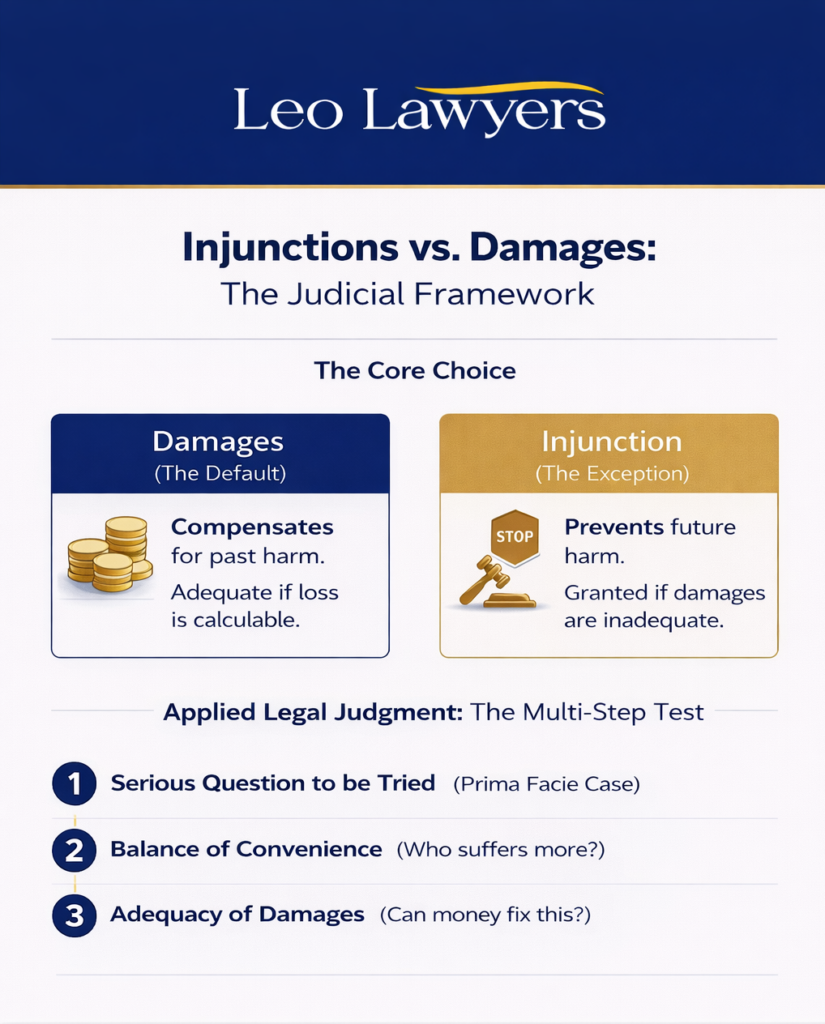
In litigation, understanding the differences between injunctions and damages is crucial when determining appropriate remedies. While both are mechanisms used in courts to enforce legal rights and deter wrongdoing, their purposes, timing, and impacts differ significantly. An injunction is primarily concerned with preventing future harm, whereas damages seek to compensate for harm already suffered.
Nature of the Remedy: Prevention vs. Compensation
An injunction is a court order that either restrains a person from doing something (prohibitory) or compels them to do something (mandatory). It is used when monetary compensation is inadequate. By contrast, damages aim to restore the injured party to the position they were in before the wrongdoing.
Importantly, the Supreme Court has the discretion to award damages in addition to, or in substitution for, an injunction. However, establishing that damages are “inadequate” remains a high bar.
Adequacy of Damages: Real-World Application
The courts are generally cautious in granting injunctions where other remedies are sufficient.
-
In Regeneron Pharmaceuticals v Sandoz (2025), the Federal Court recently refused an injunction in a high-stakes patent dispute. Even though a mandatory 25% price drop would occur if the competitor launched, the court held that the resulting loss of revenue was ultimately calculable and compensable by damages. This confirms that even massive financial shifts do not automatically make damages “inadequate.”
-
Conversely, in Aqualand North Sydney v The Owners (2025), the NSW Court of Appeal upheld a freezing order against a developer. Because the developer was a Special Purpose Vehicle (SPV) likely to distribute its only assets before trial, the court found damages would be an “inadequate” remedy because they would be impossible to collect.
Timing and Purpose of Injunctions
One of the most significant attributes of an injunction is its timing. In the Supreme Court, an injunction can be granted at any stage—before, during, or after litigation. In cases involving imminent threats, injunctions can be granted before harm even occurs, provided there is a “reasonable apprehension” of a breach.
Practical Implications and Court Discretion
The grant of an injunction is always at the court’s discretion, considering the balance of convenience and the rights of innocent third parties.
-
Undertakings: Applicants are usually required to provide an “undertaking as to damages.” As established in the classic authority Beecham Group Ltd v Bristol Laboratories (1968), this ensures that if the injunction is later found to be wrongly granted, the respondent is compensated for their losses.
-
Mandatory Injunctions: These are rarer and require “considerable restraint.” In Redbubble Ltd v Hells Angels (2024), the Full Federal Court recently showed how it carefully tailors final injunctions to ensure they protect rights without imposing impossible or non-compliant obligations on a business.
Why Strategic Counsel is Essential
At Leo Lawyers, we understand that seeking an injunction is a high-stakes strategic move. Whether you are seeking a freezing order to protect assets from a dissolving SPV or defending against a mandatory injunction that threatens your operations, feel free to contact Damin Murdock at Leo Lawyers via our website, on (02) 8201 0051 or at office@leolawyers.com.au. Further, if you liked this article, please subscribe to our newsletter via our Website, and subscribe to our YouTube, LinkedIn, Facebook and Instagram. If you liked this article or video, please also give us a favourable Google Review.
DISCLAIMER: This is not legal advice and is general information only. You should not rely upon the information contained in this article, and if you require specific legal advice, please contact us.

Damin Murdock (J.D | LL.M | BACS - Finance) is a seasoned commercial lawyer with over 17 years of experience, recognised as a trusted legal advisor and courtroom advocate who has built a formidable reputation for delivering strategic legal solutions across corporate, commercial, construction, and technology law. He has held senior leadership positions, including director of a national Australian law firm, principal lawyer of MurdockCheng Legal Practice, and Chief Legal Officer of Lawpath, Australia's largest legal technology platform. Throughout his career, Damin has personally advised more than 2,000 startups and SMEs, earning over 300 five-star reviews from satisfied clients who value his clear communication, commercial pragmatism, and in-depth legal knowledge. As an established legal thought leader, he has hosted over 100 webinars and legal videos that have attracted tens of thousands of views, reinforcing his trusted authority in both legal and business communities."
