
Employee Share Option Plans (ESOPs) have become a valuable tool for Australian startups aiming to attract, retain, and motivate talented employees. By offering staff a financial stake in the company’s future, ESOPs align incentives and foster long-term loyalty.
The Division 1A Framework
Since the 2022 reforms (commencing 1 October 2022), employee share schemes (ESS/ESOPs) have been governed by Division 1A of Part 7.12 of the Corporations Act 2001 (Cth). The Division 1A regime was introduced to reduce red tape and largely superseded the previous reliance on ASIC Class Orders CO 14/1000 (listed bodies) and CO 14/1001 (unlisted bodies), noting those class orders continued to operate on a transitional, time‑limited basis for certain offers.
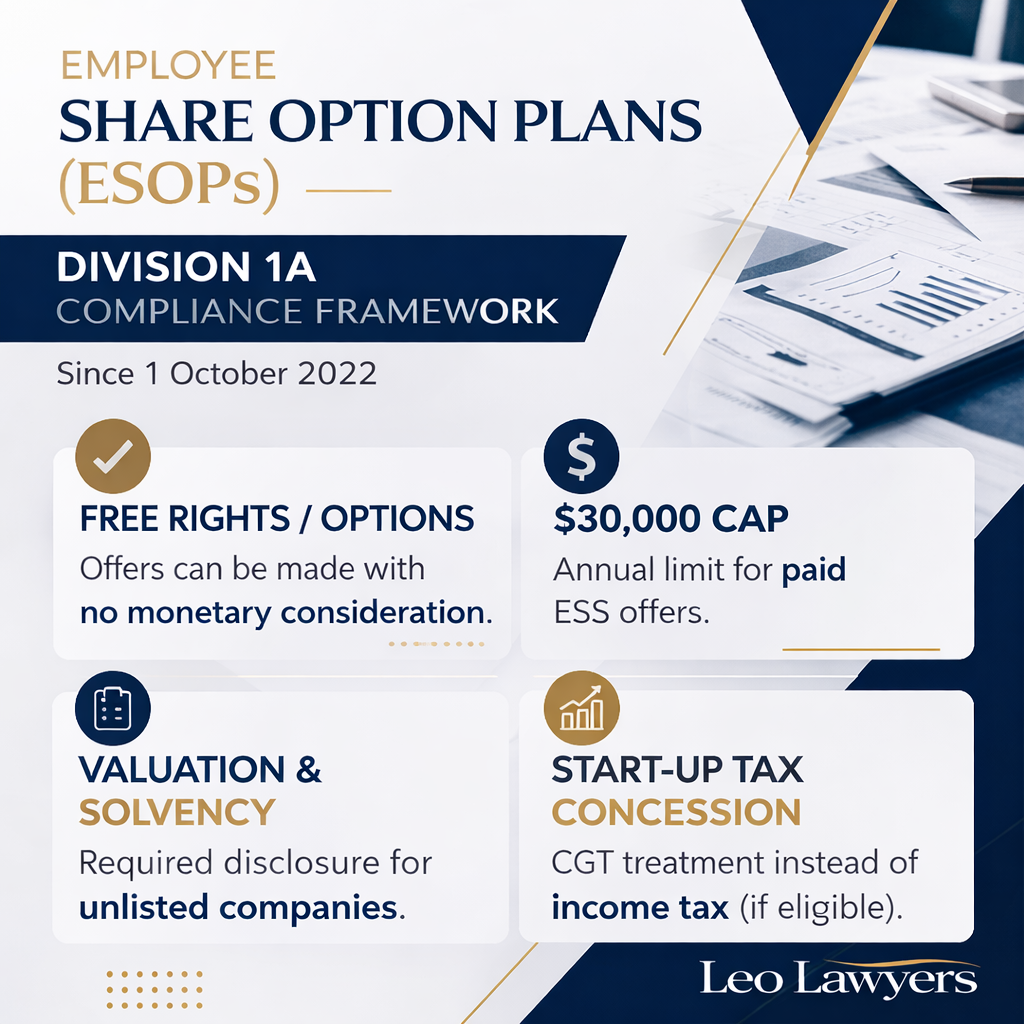
Key Corporations Act Compliance Points
1) Offers for no monetary consideration (“free” rights/options)
Division 1A expressly contemplates that an offer of ESS interests for no consideration can be made under the Division’s relief framework. In practice, if the Division 1A conditions are met, a company can generally make these offers without a prospectus/PDS, although issuers commonly still provide an ESS offer document/terms for governance and risk management.
2) The $30,000 monetary cap (unlisted offers requiring payment)
For unlisted companies relying on Division 1A for offers that require monetary consideration, a monetary cap applies. In broad terms, the cap limits a participant’s outlay to $30,000 in a 12‑month period, plus 70% of dividends and 70% of cash bonuses received in that year. For option plans, unused cap amounts can generally be carried forward on a rolling basis for up to 5 years, up to a maximum accrued cap of $150,000 (noting the dividends/bonus component does not accrue).
3) Solvency / valuation and streamlined disclosure (unlisted)
Where an unlisted company relies on Division 1A for offers requiring monetary consideration, the regime contemplates streamlined disclosure, commonly including a solvency statement and a defensible valuation (along with specified financial information).
ESS “Start-up Concession” (Tax)
Separately from the Corporations Act relief, the ESS start-up concession (where its conditions are satisfied) can result in the ESS discount not being included in assessable income. Instead, the employee is generally taxed under the CGT rules on disposal of the ESS interest or resulting shares (where the 50% CGT discount may be available depending on holding period rules).
Commonly cited eligibility criteria include:
-
The company is unlisted and has been incorporated for less than 10 years.
-
Aggregated turnover of less than $50 million.
-
For options/rights, the exercise price must not be less than the market value of an ordinary share at the time of grant.
Final Takeaway
Division 1A is now the core framework for ESS offers. In 2026, the main practical compliance pinch points remain: (i) whether the offer involves monetary consideration (triggering caps and more disclosure), and (ii) ensuring valuations/solvency and tax settings (including start-up concession conditions) are properly supported.
If you liked this article, please subscribe to our newsletter via our Website, and subscribe to our YouTube, LinkedIn, Facebook and Instagram. If you liked this article or video, please also give us a favourable Google Review.
DISCLAIMER: This is not legal advice and is general information only. You should not rely upon the information contained in this article, and if you require specific legal advice, please contact us.

Damin Murdock (J.D | LL.M | BACS - Finance) is a seasoned commercial lawyer with over 17 years of experience, recognised as a trusted legal advisor and courtroom advocate who has built a formidable reputation for delivering strategic legal solutions across corporate, commercial, construction, and technology law. He has held senior leadership positions, including director of a national Australian law firm, principal lawyer of MurdockCheng Legal Practice, and Chief Legal Officer of Lawpath, Australia's largest legal technology platform. Throughout his career, Damin has personally advised more than 2,000 startups and SMEs, earning over 300 five-star reviews from satisfied clients who value his clear communication, commercial pragmatism, and in-depth legal knowledge. As an established legal thought leader, he has hosted over 100 webinars and legal videos that have attracted tens of thousands of views, reinforcing his trusted authority in both legal and business communities."
