
Last Updated on 24/02/2026 by Damin Murdock
A recurring issue in commercial and employment disputes is whether a restraint of trade clause continues to bind a party after a contract has been terminated for repudiation.
The question commonly arises in urgent litigation. One party seeks to enforce a post-termination restraint, while the counterparty argues that the contract was first repudiated and therefore the restraint is no longer operative.
The answer depends on orthodox principles of termination and the construction of the restraint clause itself.
Termination for Repudiation: What Survives?
Where one party repudiates a contract and the innocent party accepts that repudiation, the contract is discharged prospectively. The parties are released from future performance of their primary obligations.
Australian courts have consistently recognised the distinction between:
-
primary obligations, being the substantive promises defining contractual performance; and
-
secondary obligations, being obligations that arise upon breach, including the obligation to pay damages.
In Galafassi v Kelly, the NSW Court of Appeal demonstrated that even where proceedings for specific performance had been commenced, a continuing repudiation could still be accepted, entitling the innocent party to terminate and pursue damages.
The survival of damages is therefore doctrinally clear.
The more difficult issue is whether a restraint of trade clause survives the same termination.
Characterising a Restraint of Trade Clause
A restraint of trade clause is ordinarily framed as a post-termination obligation restricting competitive conduct, solicitation, or dealings with clients for a defined period.
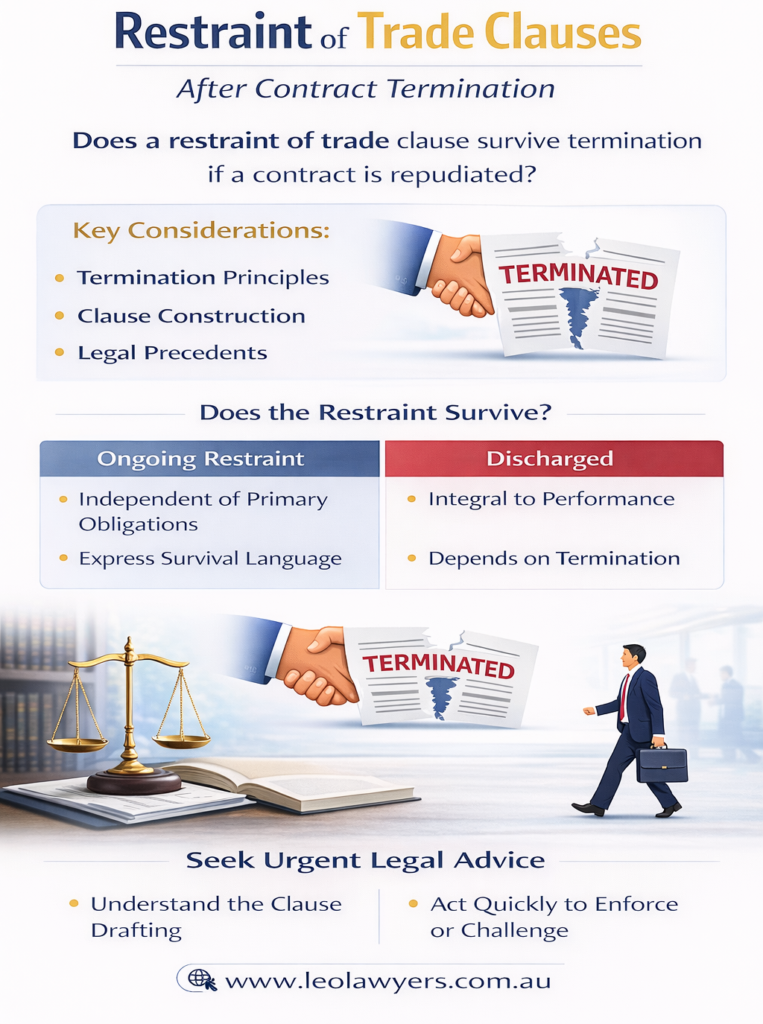
Whether such a clause survives termination for repudiation depends on construction.
If the restraint is characterised as part of the primary performance structure of the contract, acceptance of repudiation may discharge it along with other primary obligations.
However, where the drafting makes clear that the restraint is intended to operate independently of continuing performance obligations, and to survive termination regardless of the manner in which termination occurs, courts are more likely to treat it as an enforceable surviving covenant.
The position is therefore not governed by a simple rule. It turns on:
-
the language of the restraint clause;
-
any express survival provisions;
-
the interaction between termination and restraint clauses; and
-
which party committed the repudiatory conduct.
In NSW, enforceability is also subject to the Restraints of Trade Act 1976 (NSW), which permits courts to read down unreasonable restraints rather than invalidate them entirely. However, that statutory inquiry arises only if the restraint remains operative as a matter of contractual construction.
The Practical Litigation Issue
In practice, disputes about restraint survival often emerge in contentious exits where termination itself is disputed.
The real contest frequently becomes a threshold question:
Who repudiated first, and was that repudiation lawfully accepted?
If a party purports to terminate a contract in circumstances amounting to repudiation, it may retain a damages claim but lose the benefit of a restraint that is not clearly drafted to survive termination.
Conversely, a departing party who assumes that termination automatically extinguishes a restraint may face urgent interlocutory proceedings if the clause is framed as an independent surviving obligation.
In Supreme Court injunction applications, the sequencing of events: correspondence, notices, conduct, and acceptance of repudiation, can determine whether a restraint remains enforceable pending trial.
The dispute is therefore not merely about reasonableness. It is often about contractual construction and termination strategy.
Drafting and Strategic Considerations
For businesses seeking to protect goodwill:
-
restraint clauses should contain clear and express survival language;
-
termination provisions should align with the intended operation of post-termination obligations;
-
agreements should address termination for breach with precision.
For individuals or counterparties:
-
the basis and lawfulness of termination should be carefully assessed before assuming a restraint has fallen away;
-
allegations of repudiation should be analysed against contemporaneous communications and conduct;
-
urgent advice may be required where injunctive relief is threatened.
Conclusion
Termination for repudiation discharges future performance but preserves the right to damages. Whether a restraint of trade clause survives that termination depends on contractual construction, drafting, and the conduct leading to discharge.
In contentious commercial exits, the interaction between repudiation and restraint drafting can materially affect enforceability and injunctive risk.
If you are involved in a dispute concerning termination and post-termination restraints, obtaining early strategic advice may significantly affect the outcome.
Feel free to contact Damin Murdock at Leo Lawyers via our website, on (02) 8201 0051 or at office@leolawyers.com.au. Further, if you liked this article, please subscribe to our newsletter via our Website, and subscribe to our YouTube, LinkedIn, Facebook and Instagram. If you liked this article or video, please also give us a favourable Google Review.
DISCLAIMER: This is not legal advice and is general information only. You should not rely upon the information contained in this article, and if you require specific legal advice, please contact us.

Damin Murdock (J.D | LL.M | BACS - Finance) is a seasoned commercial lawyer with over 17 years of experience, recognised as a trusted legal advisor and courtroom advocate who has built a formidable reputation for delivering strategic legal solutions across corporate, commercial, construction, and technology law. He has held senior leadership positions, including director of a national Australian law firm, principal lawyer of MurdockCheng Legal Practice, and Chief Legal Officer of Lawpath, Australia's largest legal technology platform. Throughout his career, Damin has personally advised more than 2,000 startups and SMEs, earning over 300 five-star reviews from satisfied clients who value his clear communication, commercial pragmatism, and in-depth legal knowledge. As an established legal thought leader, he has hosted over 100 webinars and legal videos that have attracted tens of thousands of views, reinforcing his trusted authority in both legal and business communities."
