
Last Updated on 16/02/2026 by Damin Murdock
Practice Area: Employment & Industrial Relations
Jurisdiction: Australia (national system employers under the Fair Work Act 2009 (Cth))
Reviewed by: Damin Murdock, Employment & Industrial Relations Lawyer at Leo Lawyers.
Source verification: Cross-checked against the Hospitality Industry (General) Award 2020 and Fair Work Ombudsman guidance.
Key Takeaways
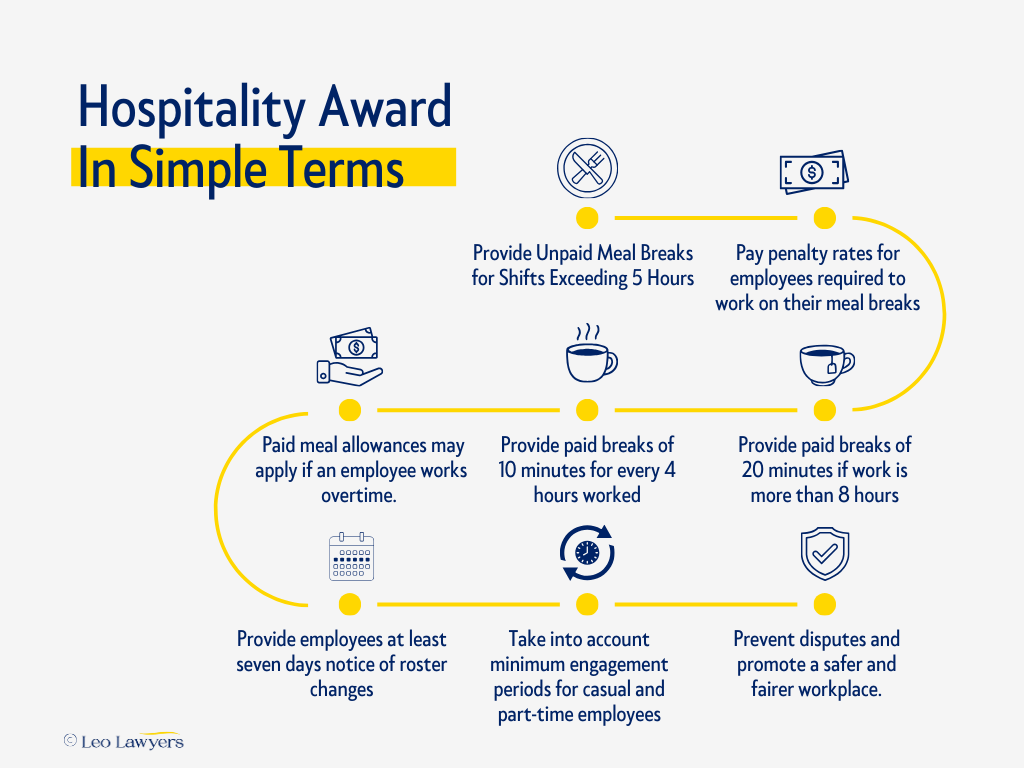
- If an employee works more than five hours, they must receive an unpaid meal break.
- Paid rest breaks apply during longer shifts.
- If staff are required to work through a meal break, they must be paid until a proper break is taken.
- Roster changes usually require at least seven days’ notice.
- Casual and part-time staff have minimum engagement periods.
- Employers must keep clear, accurate time and wage records.
Why Breaks and Rostering Compliance Matters
Hospitality is fast-paced and physically demanding. Long shifts, late finishes, and changing rosters are common, which is exactly why the Hospitality Industry (General) Award 2020 sets strict rules around breaks and rostering.
Employers who fail to comply may face the following.
- Fair Work Ombudsman investigations
- Back-pay liabilities and compliance notices
- Civil penalties for Award breaches
- Increased fatigue-related safety risks
- Higher staff turnover and workplace disputes.
In our experience, Fair Work audits often escalate simply because employers cannot produce consistent records, even where wages were otherwise paid correctly.
Meal Breaks Under the Hospitality Award
If an employee works more than five hours, they must be provided with an unpaid meal break of 30 to 60 minutes.
Key meal break rules
- Meal breaks are unpaid.
- Breaks must be taken away from work duties.
- If an employee is required to work through their meal break, they must continue to be paid until a proper break is provided.
- Meal allowances may apply where overtime is worked without sufficient notice.
Rest Breaks (Tea Breaks)
The Award also requires paid rest breaks:
- One paid 10-minute break for every four hours worked, or
- A paid 20-minute break for shifts exceeding eight hours.
Rest breaks:
- Must occur during working hours
- Cannot be taken at the start or end of a shift
- Exist to manage fatigue and reduce safety risks
Rostering Rules and Roster Changes
Under the Hospitality Award:
Notice of roster changes
- Employees must usually receive at least seven days’ notice
- Shorter notice is only permitted where the Award allows or by agreement
Minimum engagement periods
- Casual employees: minimum two hours per shift
- Part-time employees: minimum hours as agreed in their part-time arrangement
Failure to follow rostering rules can lead to disputes and applications before the Fair Work Commission.
Record Keeping and Practical Compliance
Employers must keep accurate records of hours, breaks, and wages.
Best practice includes:
- Electronic rostering and time-and-attendance systems
- Written confirmation of roster changes
- Consulting staff where hours or patterns change
- Retaining records for at least seven years
What We Commonly See in Fair Work Audits
From hospitality compliance reviews handled by Leo Lawyers, the most frequent issues include:
- Staff working through unpaid meal breaks without pay
- Rest breaks skipped during busy service periods
- Insufficient notice of roster changes
- Minimum casual engagements not applied
- Incomplete or inconsistent records
These issues regularly lead to back-pay obligations and regulatory action.
Employer Compliance Checklist
Hospitality employers should ensure:
- Meal breaks are provided for shifts over five hours
- Employees are paid if required to work through breaks
- Paid rest breaks are provided during long shifts
- Roster changes give at least seven days’ notice
- Minimum engagements apply to casual and part-time staff
- Accurate records of rosters, breaks, and hours are maintained
- Rostering practices are reviewed regularly
How Leo Lawyers Helps Hospitality Employers
Our employment team advises cafés, restaurants, venues, and hotel operators on:
- Compliance audits
- Fair Work Ombudsman responses
- Back-pay calculations
- Rostering system upgrades
- Time-and-attendance processes
We focus on practical, commercially realistic solutions, not just legal theory.
Frequently Asked Questions
Are meal breaks paid?
Generally no. If an employee works through the break, they must be paid until a proper break is taken.
How many rest breaks apply?
A paid 10-minute break every four hours, or 20 minutes for shifts over eight hours.
How much notice is required for roster changes?
Usually seven days, unless the Award allows otherwise or there is agreement.
Do casuals have minimum shift lengths?
Yes. Casual employees are generally entitled to a minimum two-hour engagement.
Disclaimer: This article provides general information only and does not constitute legal advice. Award interpretations may change. You should obtain specific legal advice for your circumstances.

Damin Murdock (J.D | LL.M | BACS - Finance) is a seasoned commercial lawyer with over 17 years of experience, recognised as a trusted legal advisor and courtroom advocate who has built a formidable reputation for delivering strategic legal solutions across corporate, commercial, construction, and technology law. He has held senior leadership positions, including director of a national Australian law firm, principal lawyer of MurdockCheng Legal Practice, and Chief Legal Officer of Lawpath, Australia's largest legal technology platform. Throughout his career, Damin has personally advised more than 2,000 startups and SMEs, earning over 300 five-star reviews from satisfied clients who value his clear communication, commercial pragmatism, and in-depth legal knowledge. As an established legal thought leader, he has hosted over 100 webinars and legal videos that have attracted tens of thousands of views, reinforcing his trusted authority in both legal and business communities."
