
Last Updated on 13/03/2026 by Damin Murdock
An Employee Share Option Plan (ESOP) is a powerful tool for startups looking to reward key employees without immediate cash outlay. However, success depends on balancing employee incentives with the protection of existing shareholder equity. In Australia, this involves navigating the Division 1A of Part 7.12 of the Corporations Act 2001 (Cth) for regulatory compliance while using robust plan rules to manage dilution.
Core Elements of an Effective ESOP
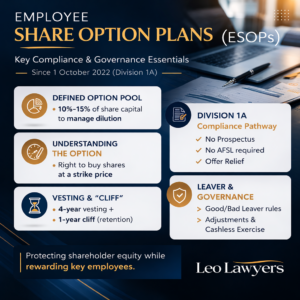
1. Defined Option Pool and Commercial Norms Startups typically allocate an Option Pool—often between 10% and 15% of the total share capital. While this is a commercial norm rather than a legal requirement, setting a hard cap in your Constitution or Shareholders’ Agreement (SHA) ensures that dilution is predictable for existing investors.
2. Understanding the Option An option is a right to acquire an ordinary share at a later date at a predetermined “strike price.” Ownership only transfers when the option is “exercised,” usually after a vesting period.
3. Vesting and the “Cliff” To ensure retention, options should vest over time (commonly 4 years). A one-year “cliff” is standard, meaning an employee must remain with the company for at least 12 months before any options vest. If they leave before the cliff, they forfeit their entire allocation.
Regulatory Compliance: The Division 1A Pathway
Division 1A provides a streamlined relief pathway for companies making offers under an Employee Share Scheme (ESS). It offers exemptions from traditional disclosure (prospectus), licensing (AFSL), and advertising restrictions.
The Monetary Cap for Unlisted Companies For unlisted companies making offers that require a cash outlay (monetary consideration) from the employee:
-
The Cap: A participant’s outlay is generally capped at $30,000 per 12-month period (plus 70% of dividends and 70% of cash bonuses).
-
Exercise of Options: This cap includes amounts payable upon the exercise of options.
-
Carry-Forward: For option plans, unused cap amounts can often be carried forward for up to five years, allowing for a maximum accrued cap of $150,000 for a specific exercise event.
Protecting Shareholder Equity through Governance
While Division 1A handles the “how” of making an offer, your Plan Rules handle the protection of equity:
-
Adjustment Provisions: Well-drafted plans include mechanics to adjust the number of options in the event of a reorganization, bonus issue, or share split. This preserves the economic equivalence of the options for the employee without unintended dilution of the founders.
-
Cashless Exercise (Net Settlement): This allows an employee to exercise their options by receiving a number of shares equal in value to the “spread” (the difference between the market price and the strike price). This can reduce the total number of new shares issued compared to a full physical exercise.
-
Leaver Provisions:
- Good Leaver: Usually retains vested options but forfeits unvested ones.
-
Bad Leaver: (e.g., termination for serious misconduct). Usually forfeits all options. Note that “Bad Leaver” clauses must be drafted carefully to ensure they are enforceable and not characterized as a penalty.
Final Thoughts
Structuring an ESOP requires aligning your Plan Rules with your Shareholders’ Agreement while ensuring you fit within the Division 1A relief framework. Because valuations and tax settings (such as the ESS Startup Concession) are highly technical, professional advice is essential to ensure the plan achieves its retention goals without creating a compliance burden.
If you liked this article, please subscribe to our newsletter via our Website, and subscribe to our YouTube, LinkedIn, Facebook and Instagram. If you liked this article or video, please also give us a favourable Google Review.
DISCLAIMER: This is not legal advice and is general information only. You should not rely upon the information contained in this article, and if you require specific legal advice, please contact us.

Damin Murdock (J.D | LL.M | BACS - Finance) is a seasoned commercial lawyer with over 17 years of experience, recognised as a trusted legal advisor and courtroom advocate who has built a formidable reputation for delivering strategic legal solutions across corporate, commercial, construction, and technology law. He has held senior leadership positions, including director of a national Australian law firm, principal lawyer of MurdockCheng Legal Practice, and Chief Legal Officer of Lawpath, Australia's largest legal technology platform. Throughout his career, Damin has personally advised more than 2,000 startups and SMEs, earning over 300 five-star reviews from satisfied clients who value his clear communication, commercial pragmatism, and in-depth legal knowledge. As an established legal thought leader, he has hosted over 100 webinars and legal videos that have attracted tens of thousands of views, reinforcing his trusted authority in both legal and business communities."
