
Last Updated on 16/03/2026 by Damin Murdock
Injunctions are a powerful remedy in Australian law, used to either restrain a party from taking a specific action or compel them to perform a particular duty. Under both statutory and common law, the courts can grant multiple types of injunctions depending on the circumstances of each case, with the flexibility to issue interim or permanent orders. Whether you’re seeking an urgent relief to preserve your rights or final orders to prevent the ongoing breaches from the other party, it is essential to understand the types, requirements, and implications of the available injunctions.
Types of Injunctions
-
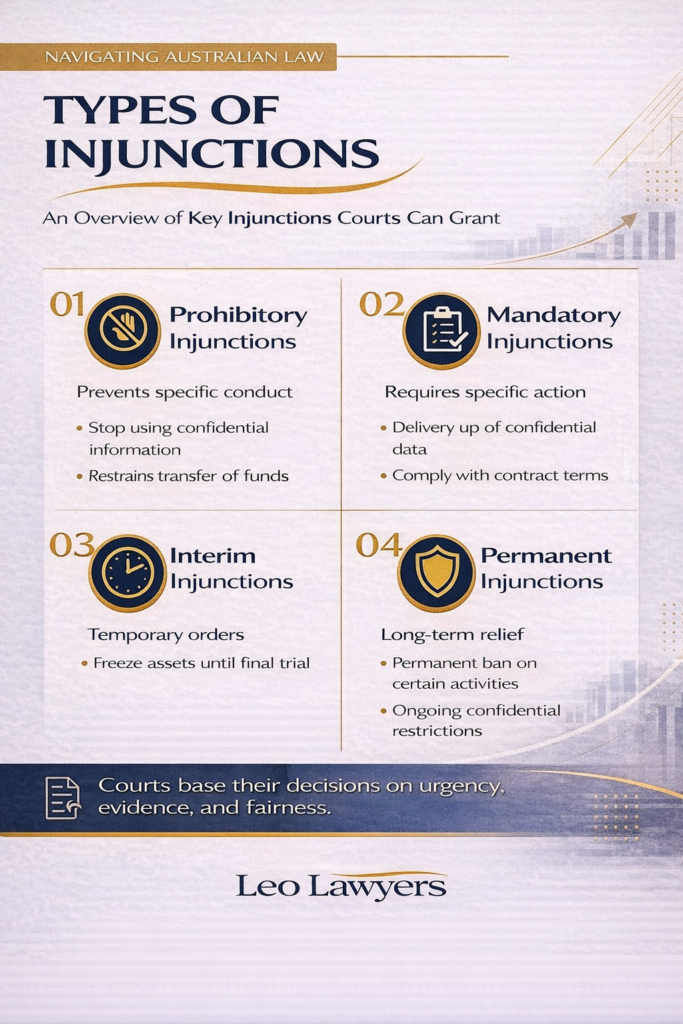
Prohibitory Injunctions
Prohibitory injunctions are designed to prevent or restrain a particular conduct. They are the most commonly granted form of injunction and may be issued regardless of whether:
- the respondent has previously engaged in the prohibited conduct;
- there is an ongoing threat of repeated conduct; or
- there is imminent danger of substantial damage.
The focus is on preserving the status quo and preventing harm before it occurs, and courts have a broad discretion to issue these injunctions when satisfied that the balance of convenience supports such a restraint. Examples of prohibitory injunctions are restraints on the transfer of funds, the use of confidential information, or working for a competitive company.
-
Mandatory Injunctions
In contrast to prohibitory injunctions, mandatory injunctions can compel a person or entity to perform specific conducts or duties. These are typically more difficult to obtain because they require the court to oversee compliance with an affirmative obligation. To succeed, the applicant must be able to demonstrate that:
- the respondent has failed or refused to perform the act; and
- there is a strong likelihood of continued non-compliance or breach.
Mandatory injunctions are often sought in situations involving breach of contract, property disputes, or regulatory non-compliance. Examples of mandatory injunction is the delivery up of confidential information or restraining someone permanently from working for a competitive business in accordance with a restraint of trade or non-complete clause in an employment contract, contractors agreement or shareholders agreement.
-
Interim Injunctions
An interim (or interlocutory) injunction is a temporary order granted to preserve rights or prevent irreparable harm until a final hearing can determine the issues. A common precondition is that the applicant provides an undertaking as to damages, meaning they agree to compensate the respondent if it is later found that the injunction was improperly granted.
However, certain public bodies, such as commissioners or regulators, may be exempt from giving undertakings, depending on the nature of the proceeding and the statutory authority they operate under. Examples of an interim injunction is to restrain someone from transferring funds or disposing of assets until the final outcome of a case, such as a breach of contract claim.
-
Permanent Injunctions
A permanent injunction is granted after a full hearing of the case. It may incorporate both prohibitory and mandatory elements and is designed to offer permanent or final relief. In some cases, it may be accompanied by an award of damages to compensate the applicant for any harm suffered.
-
Ex Parte Injunctions
An ex parte injunction is issued without notice to the respondent, typically in emergency situations where immediate action is necessary. These orders are usually short-lived and are designed to protect the applicant’s position until the other party can be heard. Examples are to freeze a bank account without the defendant’s knowledge as giving them notice would likely result in them transferring the funds before the injunction was granted.
Applicants seeking ex parte relief should provide:
- a draft statement of claim and notice of motion or summons, affidavit evidence (Evidence Act 1995 (Cth) s 75); and
- full disclosure of all matters which may affect the right to the orders.
The Court’s Powers Regarding Injunctions
Courts not only have the power to issue injunctions but also they can:
- vary or discharge existing injunctions as circumstances evolve;
- impose conditions tailored to the needs of the case; and
- award damages in addition to, or in place of, an injunction where appropriate.
These powers operate in addition to other remedies and are not limited by statutory provisions unless expressly stated.
Key Considerations
-
Threshold Requirements
To obtain an injunction, an applicant must demonstrate either past misconduct or a strong likelihood of future misconduct. Contrary to popular belief, there is no strict requirement to show that the danger is imminent in all cases, particularly in mandatory injunctions where refusal or failure is ongoing.
-
Discretionary Relief
Injunctions are never granted as of right. Courts retain a broad discretion to refuse relief or tailor it with specific terms. They will weigh factors such as the balance of convenience, whether damages would be an adequate remedy, and whether the conduct affects the public interest.
-
Practical Application
Injunctions are often sought in conjunction with other remedies, such as declarations or damages. They play a vital role in commercial disputes, intellectual property protection, employment contracts, and regulatory enforcement. Practitioners and litigants must consider both legal and strategic implications when seeking such orders.
Feel free to contact Damin Murdock at Leo Lawyers via our website, on (02) 8201 0051 or at office@leolawyers.com.au. Further, if you liked this article, please subscribe to our newsletter via our Website, and subscribe to our YouTube , LinkedIn, Facebook and Instagram. If you liked this article or video, please also give us a favourable Google Review.
DISCLAIMER: This is not legal advice and is general information only. You should not rely upon the information contained in this article and if you require specific legal advice, please contact us.

Damin Murdock (J.D | LL.M | BACS - Finance) is a seasoned commercial lawyer with over 17 years of experience, recognised as a trusted legal advisor and courtroom advocate who has built a formidable reputation for delivering strategic legal solutions across corporate, commercial, construction, and technology law. He has held senior leadership positions, including director of a national Australian law firm, principal lawyer of MurdockCheng Legal Practice, and Chief Legal Officer of Lawpath, Australia's largest legal technology platform. Throughout his career, Damin has personally advised more than 2,000 startups and SMEs, earning over 300 five-star reviews from satisfied clients who value his clear communication, commercial pragmatism, and in-depth legal knowledge. As an established legal thought leader, he has hosted over 100 webinars and legal videos that have attracted tens of thousands of views, reinforcing his trusted authority in both legal and business communities."
