
Last Updated on 30/03/2026 by Damin Murdock
In residential construction, builders often find themselves caught between conflicting documents or verbal instructions from a spouse or consultant. While it may seem easier to “just get on with the job,” a failure to strictly adhere to the notice provisions in a building contract can result in a builder being liable for rectification costs, even if they believed they were doing the right thing.
Case Analysis: Watson v Gremmo Homes Pty Ltd
A recent review of building disputes highlights the critical importance of the case Watson v Gremmo Homes Pty Ltd. In this matter, a builder and owner entered into a standard HIA building contract for $681,000.
The Conflict: The contract documents were inconsistent: the plans required hob-less showers, but the selection schedule specified hob waterproofing. The builder proceeded to construct showers with hobs, later claiming they were following verbal instructions from the owner’s husband.
The Legal Failure: The Tribunal focused on two specific failures of applied judgment by the builder:
-
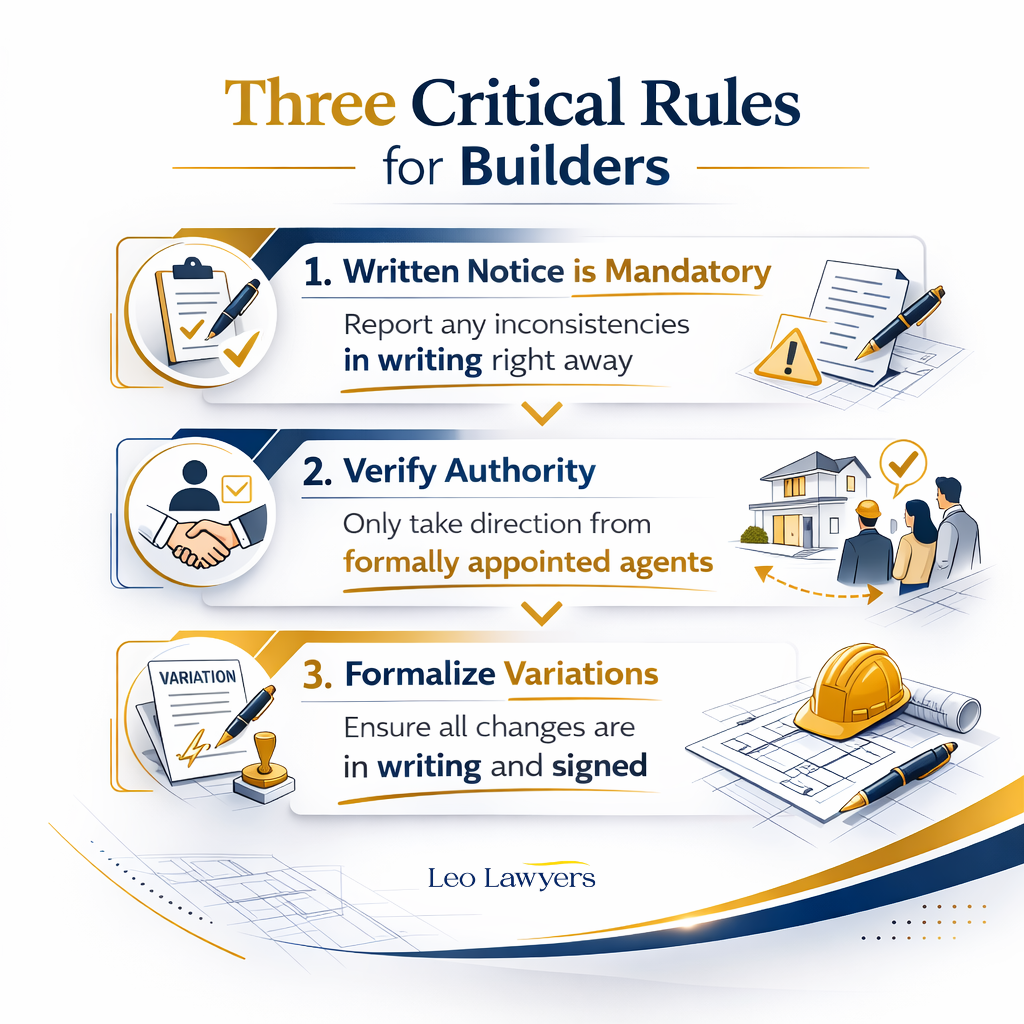
Failure to Notify: The contract required any party who became aware of an inconsistency to give written notice to the other within two working days. The builder noticed the conflict but failed to report it in writing.
-
The Agency Trap: The builder assumed the owner’s husband was acting as her agent. However, he was not formally appointed as an agent in the contract. Relying on his verbal “acceptance” of the hobs did not override the builder’s written obligations to the actual homeowner.
The Outcome: The builder was found in breach of contract. The owner was awarded rectification costs to tear out and rebuild the showers to match the original plans. While the owner’s claim for alternative accommodation was denied (as the showers could be fixed one by one), the financial and reputational cost to the builder was significant.
Feel free to contact Damin Murdock at Leo Lawyers via our website, on (02) 8201 0051 or at office@leolawyers.com.au. Further, if you liked this article, please subscribe to our newsletter via our Website, and subscribe to our YouTube, LinkedIn, Facebook and Instagram. If you liked this article or video, please also give us a favourable Google Review.
DISCLAIMER: This is not legal advice and is general information only. You should not rely upon the information contained in this article, and if you require specific legal advice, please contact us.

Damin Murdock (J.D | LL.M | BACS - Finance) has over 17 years of experience as a commercial lawyer. He helps businesses navigate construction and technology law. Damin has held several big leadership roles, including serving as a director of a national law firm and the Chief Legal Officer for Lawpath.
He has personally helped more than 2,000 startups and small businesses. With over 300 five-star reviews, his clients clearly value his practical advice and simple way of explaining things. Damin has also hosted over 100 webinars that thousands of people have watched to get reliable legal help.
