
Last Updated on 22/01/2026 by Damin Murdock
The Full Federal Court of Australia (the “Full Court”) has recently made a landmark decision in Richardson v Oracle Corporation Australia Pty Ltd [2014] FCAFC 82 (the “Richardson Case”) by awarding an unprecedented amount in compensation for the pain and suffering of a sexual harassment victim in the workplace.
In the preceding Federal Court Hearing, which was before Justice Buchanan in February last year, Ms Richards+-on, a former employee of the Oracle Corporation Australia (“Oracle”), was awarded damages in the amount of $18,000 after Oracle was found to be vicariously liable for the actions of another employee, Mr Tucker, who made sexual advances and humiliating comments toward her.
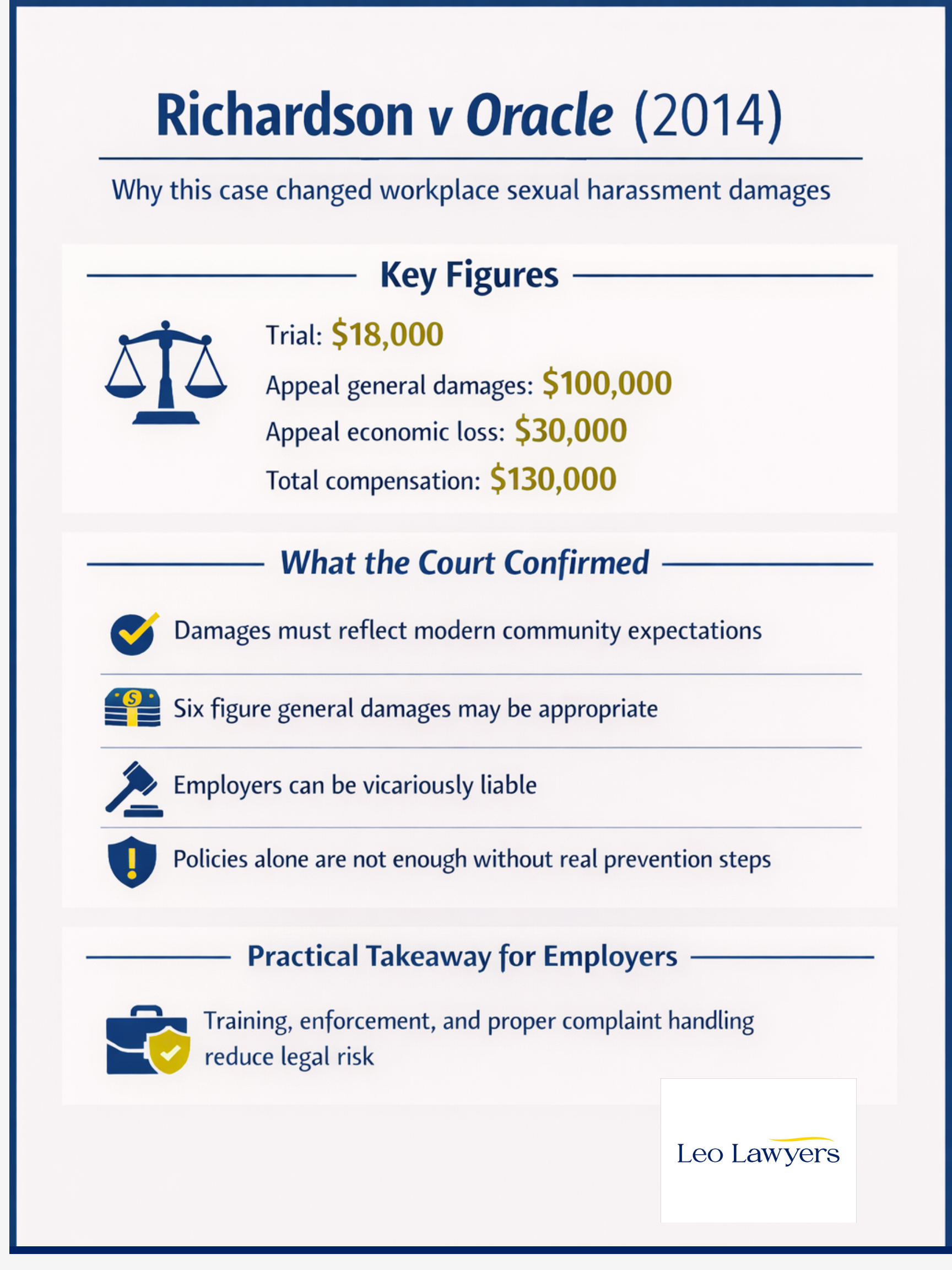
On appeal, the Full Court increased Ms Richardson’s compensation to$100,000 after taking the view that $18,000 did not adequately cover the distress suffered by Ms Richardson in light of her treatment by Mr Tucker, nor did it adequately reflect society’s expectations of how sexual harassment victims should be compensated.
Additionally, Ms Richardson was awarded a further $30,000 in economic damages as the Full Court sufficiently established a causal link between Ms Richardson’s treatment by Mr Tucker and her subsequent decision to resign from her position with Oracle in 2010.
Significance of the Decision
A New Benchmark for Damages
At the time, the $100,000 award for general damages was unprecedented in Australian sexual harassment cases. The decision marked a clear shift away from historically modest awards and aligned sexual harassment damages with other areas of law involving personal and reputational harm.
Recognition of Community Standards
The Full Court expressly stated that damages should reflect contemporary community expectations. Sexual harassment was no longer to be treated as a lesser workplace harm deserving of nominal compensation.
Reinforcement of Employer Liability
The case reaffirmed that employers will be held vicariously liable for employee misconduct unless they can demonstrate that they took all reasonable steps to prevent it. Written policies alone are not sufficient. Employers must show active enforcement, training, and effective complaint handling.
Practical Implications for Employers
Richardson v Oracle serves as a warning to employers that failures in workplace culture, training, or response mechanisms can result in substantial financial liability. Robust prevention systems, regular training, and prompt investigation of complaints are essential risk management tools.
This image and its contents are protected by copyright under Australian law and international treaties. Leo Lawyers Pty Limited reserves those rights.
Conclusion
Richardson v Oracle Corporation Australia Pty Ltd [2014] FCAFC 82 remains a leading authority on damages for workplace sexual harassment in Australia. It reshaped judicial attitudes to compensation, confirmed the seriousness with which such conduct must be treated, and reinforced the legal consequences for employers who fail to prevent harassment in the workplace.
If you have any questions in relation to this article, please contact Damin Murdock at Leo Lawyers on (02) 8201 0051 or at office@leolawyers.com.au.
DISCLAIMER: This article is not to be taken as legal advice and is general in nature. If you require specific advice, please contact us.

Damin Murdock (J.D | LL.M | BACS - Finance) is a seasoned commercial lawyer with over 17 years of experience, recognised as a trusted legal advisor and courtroom advocate who has built a formidable reputation for delivering strategic legal solutions across corporate, commercial, construction, and technology law. He has held senior leadership positions, including director of a national Australian law firm, principal lawyer of MurdockCheng Legal Practice, and Chief Legal Officer of Lawpath, Australia's largest legal technology platform. Throughout his career, Damin has personally advised more than 2,000 startups and SMEs, earning over 300 five-star reviews from satisfied clients who value his clear communication, commercial pragmatism, and in-depth legal knowledge. As an established legal thought leader, he has hosted over 100 webinars and legal videos that have attracted tens of thousands of views, reinforcing his trusted authority in both legal and business communities."
