
Last Updated on 30/03/2026 by Damin Murdock
An injunction is a powerful remedy used by Australian courts to preserve rights, restrain harmful conduct, or compel parties to act in a certain way. When immediate relief is needed, especially before a full trial, parties may seek an interlocutory injunction. To succeed, applicants must meet a strict legal test and support their claims with detailed evidence.
This article outlines the three essential legal elements required to apply for an injunction and obtaining it, and explains the application process, evidentiary requirements, and important judicial considerations.
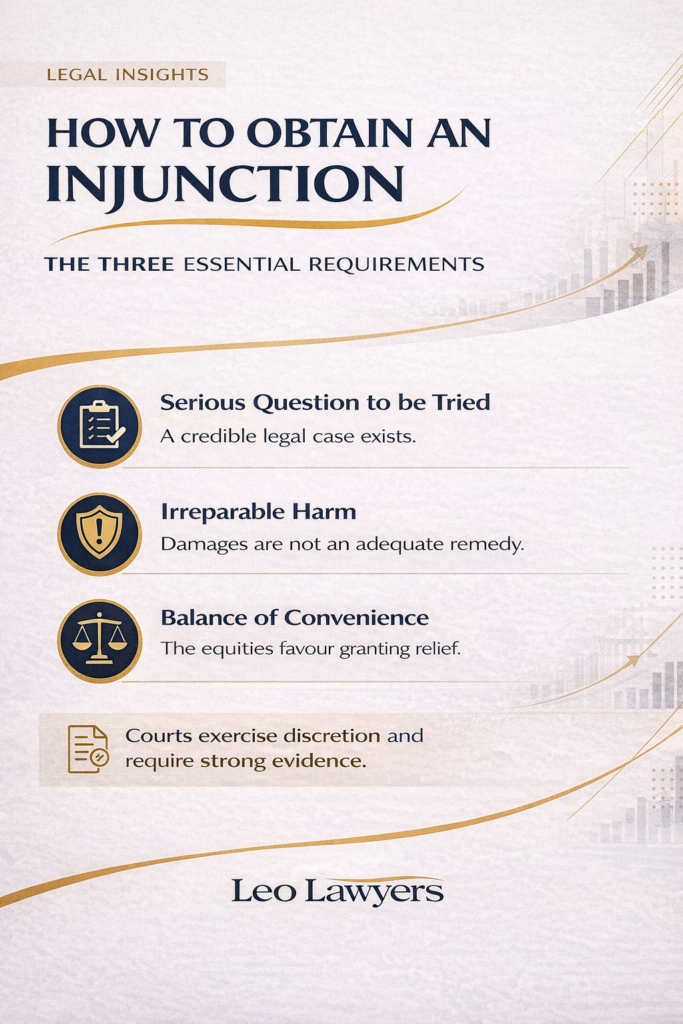
The Three Essential Requirements
To obtain an interlocutory injunction, the applicant must satisfy three core elements (see Castlemaine Tooheys Ltd v South Australia [1986] HCA 58).
-
Serious Question to be Tried
The applicant must demonstrate that there is a serious legal issue to be decided at trial. This is sometimes referred to as a prima facie case, not meaning the case will definitely succeed, but that it is credible and not frivolous or speculative. This legal or equitable right may arise from a statutory entitlement, a contractual obligation, or general legal principles.
-
Irreparable Harm
It must be shown that, unless an injunction is granted, the applicant will suffer harm that cannot be adequately compensated by damages. This could include damage to reputation, loss of unique property or intellectual property, or irreversible business impacts.
-
Balance of Convenience
The court will weigh the likely harm to the applicant if the injunction is not granted against the potential harm to the respondent if it is. If the risk of greater prejudice lies with the applicant, then the court may be inclined to grant the injunction.
The Application Process
To seek an injunction, the applicant must:
- File an application with the appropriate court
- Include a draft order setting out the precise relief sought (e.g., to stop specific conduct or require action)
- Submit a supporting affidavit outlining:
- The conduct or proposed conduct in question
- The legal or statutory basis for the claim
- Specific breaches or obligations being contravened
- Evidence supporting the three core legal requirements
In urgent matters, a notice of motion or summons may be filed, and an ex parte application (without notice to the other side) may be made in certain circumstances.
Evidence Requirements
The applicant should present strong primary and supporting evidence, including:
- Documents demonstrating a strong case on the merits (e.g., contracts, statutory rights)
- Proof of likely irreparable harm, such as potential business closure, reputational loss, or confidential information leaks
- Reasons why damages would not be adequate, such as harm that is difficult to quantify or non-monetary interests
Additional supporting materials may include:
- Relevant correspondence between the parties
- Prior breaches or failures to comply with obligations
- Witness statements or affidavits detailing past or threatened conduct
Types of Injunctions
Depending on the circumstances, the court may grant:
- Prohibitory injunctions to stop a party from engaging in particular conduct
- Mandatory injunctions to compel a party to take specific actions (these require even more rigorous evidence)
- Interim injunctions to maintain the status quo pending the final determination of the dispute.
Judicial Discretion and Key Considerations
The court’s power to grant an injunction is discretionary. The judge will assess:
- The urgency of the matter
- The impact of the injunction on all parties involved
- Whether the applicant has provided a full and frank disclosure of all relevant facts, especially in ex parte applications.
In certain cases, particularly where the government or public regulators are involved, the court may waive the requirement for an undertaking as to damages, which is typically required to protect the respondent if the injunction is later found to be unjustified. Where the application is for a mandatory injunction, additional evidence is often necessary to show a party’s refusal, or likely refusal, to perform an act.
Feel free to contact Damin Murdock at Leo Lawyers via our website, on (02) 8201 0051 or at office@leolawyers.com.au. Further, if you liked this article, please subscribe to our newsletter via our Website, and subscribe to our YouTube, LinkedIn, Facebook and Instagram. If you liked this article or video, please also give us a favourable Google Review.
DISCLAIMER: This is not legal advice and is general information only. You should not rely upon the information contained in this article, and if you require specific legal advice, please contact us.

Damin Murdock (J.D | LL.M | BACS - Finance) has over 17 years of experience as a commercial lawyer. He helps businesses navigate construction and technology law. Damin has held several big leadership roles, including serving as a director of a national law firm and the Chief Legal Officer for Lawpath.
He has personally helped more than 2,000 startups and small businesses. With over 300 five-star reviews, his clients clearly value his practical advice and simple way of explaining things. Damin has also hosted over 100 webinars that thousands of people have watched to get reliable legal help.
