
Last Updated on 30/03/2026 by Damin Murdock
When renovating or making changes to common property within a strata scheme, both lot owners and owners corporations must understand the legal thresholds for approving by-laws. One of the most common questions is whether such a by-law can be passed by an ordinary resolution or whether a special resolution is required under New South Wales strata law.
The short answer is that a by-law authorising strata renovation or granting exclusive use of common property generally requires a special resolution. This requirement is set out in sections 108 and 141 of the Strata Schemes Management Act 2015 (NSW) (the Act) and has been confirmed by multiple Tribunal and Court decisions.
When a Special Resolution Is Required
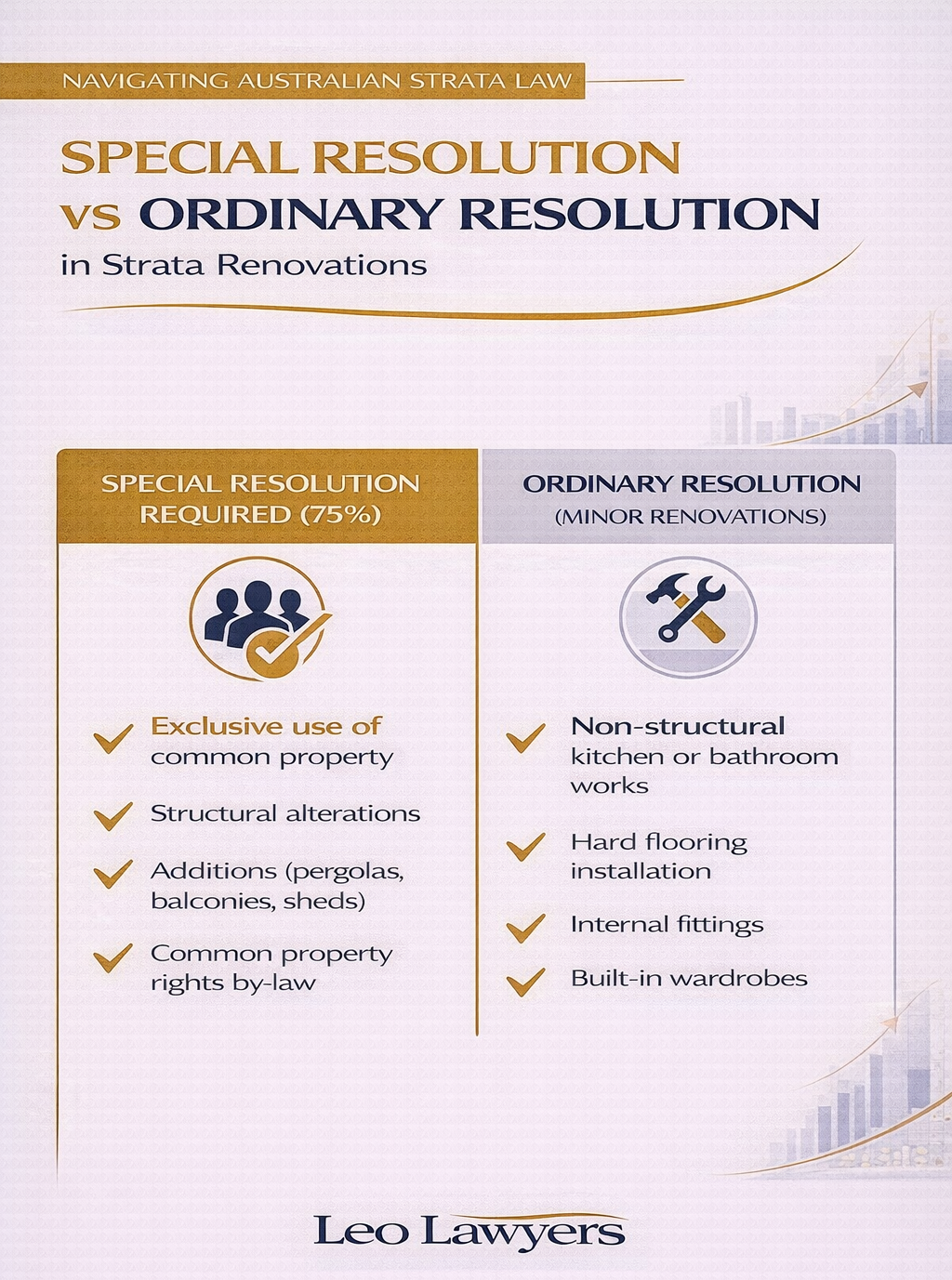
Under the Act, any common property rights by-law that authorises renovations or confers exclusive privileges over common property must be passed by a special resolution, which requires at least 75 percent of votes cast at a general meeting to be in favour.
These by-laws typically:
- Authorise works that add to, alter, or erect structures on common property
- Confer exclusive use rights or special privileges on a lot owner, such as the private use of a courtyard or parking space
- Specify who is responsible for maintaining or repairing the altered or exclusive use area
Where a by-law seeks to transfer responsibility for the maintenance of common property to an individual lot owner, the by-law must clearly define the scope of the maintenance obligation and specify whether the owners corporation or the lot owner is responsible for ongoing maintenance.
In accordance with section 108(5) of the Act, written consent from the affected lot owner is required before the by-law is made, and the by-law must clearly reflect the maintenance arrangement. These requirements have been confirmed in decisions such as The Owners – Strata Plan No 50276 v Thoo and are essential to ensure the validity and enforceability of such by-laws.
Types of Work That Require a Special Resolution
Not all works on common property are treated the same under the Act. The following types of work require approval by special resolution:
- Additions to common property, such as pergolas, fences, or extensions
- Alterations involving structural or external changes
- Erection of new structures, such as sheds, stairs, or balconies
- Any work that is not considered minor or cosmetic
The NSW Court of Appeal in Stolfa v Hempton [2010] NSWCA 218 confirmed that not all works to common property require a special resolution. If the works are properly characterised as repairs and maintenance, they may be authorised without a special resolution. However, if the works amount to an enhancement or improvement of the common property, or if they confer exclusive use or special privileges over common property, a special resolution (and, in the case of exclusive use, an appropriate by-law) is required.
What About Minor Renovations
An important exception exists for minor renovations, which can be approved by ordinary resolution under the Act. Minor renovations may include:
- Non-structural kitchen or bathroom refurbishments
- Installing hard flooring
- Replacing internal light fittings
- Adding built-in wardrobes
NCAT has clarified that works to common property by a lot owner do not require a special resolution unless they affect the building’s structure or external appearance, or confer exclusive use or special privileges. Routine works that do not have such an impact may be approved by ordinary resolution or under a by-law, but must still comply with the scheme’s authorisation requirements. However, if the proposed renovation involves exclusive use of common property or structural alterations, an ordinary resolution will not suffice.
Important Legal Considerations
If a by-law has been in place for more than two years, courts and tribunals will generally presume it was validly made, even if procedural errors occurred.
If a by-law does not explicitly allocate responsibility for maintenance and repair, the default position is that the owners corporation remains responsible. Any by-law that alters maintenance obligations cannot be amended or repealed without a special resolution, and requires the written consent of the affected lot owner.
A by-law cannot override the provisions of the Act, even when exclusive use rights are granted, the lot owner must still comply with legal obligations relating to insurance, access, and safety.
Conclusion
In summary, any by-law that authorises renovations or the use of common property must be approved by a special resolution, unless the works are strictly minor and non-structural. This ensures that changes to common property are made transparently and with sufficient support from the strata community.
Lot owners seeking renovation or exclusive use rights should also be prepared to enter into clear agreements regarding maintenance responsibilities and provide written consent where required.
Failing to obtain the correct resolution may render the by-law invalid and expose both the lot owner and the owners corporation to potential legal disputes.
Feel free to contact Damin Murdock at Leo Lawyers via our website, on (02) 8201 0051 or at office@leolawyers.com.au. Further, if you liked this article, please subscribe to our newsletter via our Website, and subscribe to our YouTube , LinkedIn, Facebook and Instagram. If you liked this article or video, please also give us a favourable Google Review.
DISCLAIMER: This is not legal advice and is general information only. You should not rely upon the information contained in this article and if you require specific legal advice, please contact us.

Damin Murdock (J.D | LL.M | BACS - Finance) has over 17 years of experience as a commercial lawyer. He helps businesses navigate construction and technology law. Damin has held several big leadership roles, including serving as a director of a national law firm and the Chief Legal Officer for Lawpath.
He has personally helped more than 2,000 startups and small businesses. With over 300 five-star reviews, his clients clearly value his practical advice and simple way of explaining things. Damin has also hosted over 100 webinars that thousands of people have watched to get reliable legal help.
