
Last Updated on 27/07/2026 by Damin Murdock
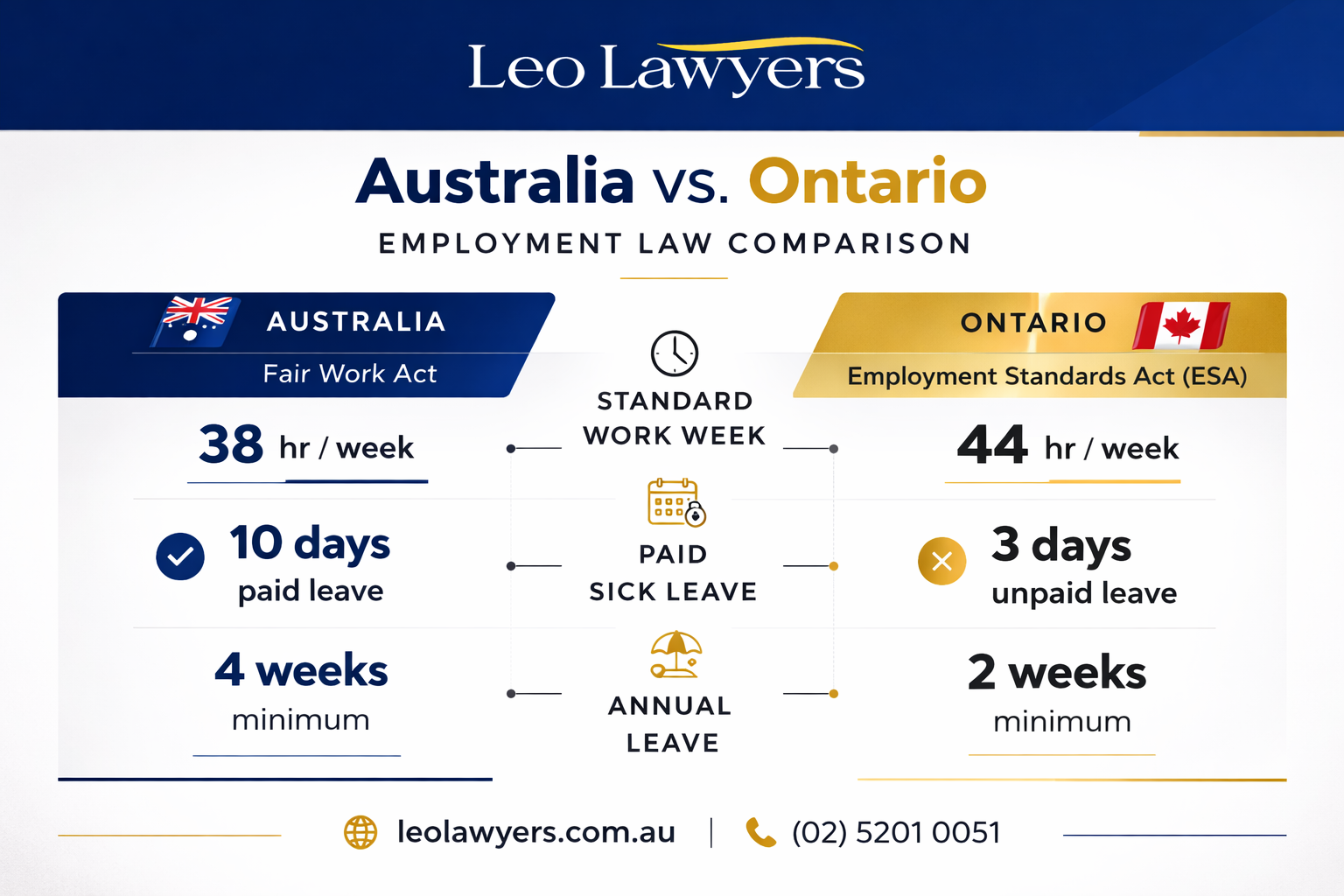
As Canadian businesses look to expand globally, Australia presents an attractive market with a stable economy and strategic location. However, for an Ontario-based company, the transition from the Employment Standards Act (ESA) to Australia’s Fair Work Act 2009 involves more than just adjusting to a 38-hour workweek. Success requires navigating the National Employment Standards (NES) and the complex “Modern Award” system.
1. Overtime and Modern Awards: Beyond the 44-Hour Week
In Ontario, the threshold for overtime is generally 44 hours. In Australia, the standard is 38 hours, but the actual cost of labour is dictated by “Modern Awards”, industry-specific instruments that override base contracts.
The interaction between these awards and the NES is a frequent point of contention. In Australian Municipal, Administrative, Clerical and Services Union v North East Water [2014] FWCFB 6927, the FWC Full Bench examined how award provisions regarding “reasonable additional hours” must be balanced against the NES. For a Canadian employer, this means that simply paying a flat salary may not satisfy Australian law if the specific Award requires penalty rates for weekend or late-night work.
Getting this right before the first hire is significantly cheaper than resolving an underpayment claim after the fact. Our commercial lawyers in Sydney advise international businesses entering the Australian market on award compliance, employment contract drafting, and the interaction between the NES and any applicable Modern Award.
2. Leave Entitlements: The Interplay of Agreements
While Ontario mandates three unpaid sick days, Australia requires 10 days of paid personal/carer’s leave and four weeks of paid annual leave.
Expert Insight: It is a common mistake for foreign firms to assume that an Enterprise Agreement or a private contract can “trade away” these NES minimums. In Qantas Airways Limited v Flight Attendants’ Association of Australia [2023] FCAFC 92, the Federal Court reinforced that the NES acts as an absolute floor. Even if an employee agrees to a different leave structure in a contract, the NES entitlements continue to accrue. They must be honoured, particularly regarding how leave interacts with public holidays and shift work.
3. Termination, Redundancy, and Unfair Dismissal
Termination in Ontario is often a matter of notice or “pay in lieu” based on tenure. In Australia, the risk is higher due to Unfair Dismissal protections.
-
The Qualifying Period
Most employees can claim unfair dismissal after six months (12 months for small businesses).
-
Redundancy
Unlike Ontario’s CAD $2.5 million payroll threshold for severance, Australian redundancy pay is triggered based on the number of employees (15 or more) and length of service. Canadian businesses must be aware that “genuine redundancy” is a specific legal defence in Australia; if the role is not truly redundant or if redeployment was possible, the business remains vulnerable to litigation. A Canadian business unfamiliar with the genuine redundancy test, or with the six-month qualifying period for unfair dismissal claims, can face Fair Work Commission proceedings on its first Australian termination. Our unfair dismissal lawyers in Sydney advise employers on defensible termination processes before the decision is made.
How Leo Lawyers Supports Canadian Expansion
Expanding into a new jurisdiction requires local expertise with a global perspective. At Leo Lawyers, we bridge the gap between North American business culture and Australian legal rigour.
Whether you are establishing a subsidiary, hiring your first Australian employees, or navigating a workplace dispute, our small business lawyers in Sydney provide the local legal foundation your expansion needs.
Feel free to contact Damin Murdock at Leo Lawyers via our website, on (02) 8201 0051 or at office@leolawyers.com.au. Further, if you liked this article, please subscribe to our newsletter via our Website, and subscribe to our YouTube, LinkedIn, Facebook and Instagram. If you liked this article or video, please also give us a favourable Google Review.
DISCLAIMER: This is not legal advice and is general information only. You should not rely upon the information contained in this article, and if you require specific legal advice, please contact us.

Damin Murdock (J.D | LL.M | BACS - Finance) has over 17 years of experience as a commercial lawyer. He helps businesses navigate construction and technology law. Damin has held several big leadership roles, including serving as a director of a national law firm and the Chief Legal Officer for Lawpath.
He has personally helped more than 2,000 startups and small businesses. With over 300 five-star reviews, his clients clearly value his practical advice and simple way of explaining things. Damin has also hosted over 100 webinars that thousands of people have watched to get reliable legal help.
