
Last Updated on 31/07/2026 by Damin Murdock
Misleading or deceptive conduct claims under the Australian Consumer Law (ACL) are a common feature of commercial disputes, particularly where one party alleges it was induced to enter a transaction by statements made during negotiations, in marketing material, or through other pre-contractual communications. While attention often centres on representations about existing facts, the ACL can also capture forward-looking statements, such as forecasts, promises, timelines and assurances about what will occur. This article outlines how s 4 of the ACL treats representations about future matters, explains the role of “reasonable grounds”, and highlights why contemporaneous evidence supporting a prediction or promise is often decisive.
Representations as to future matters
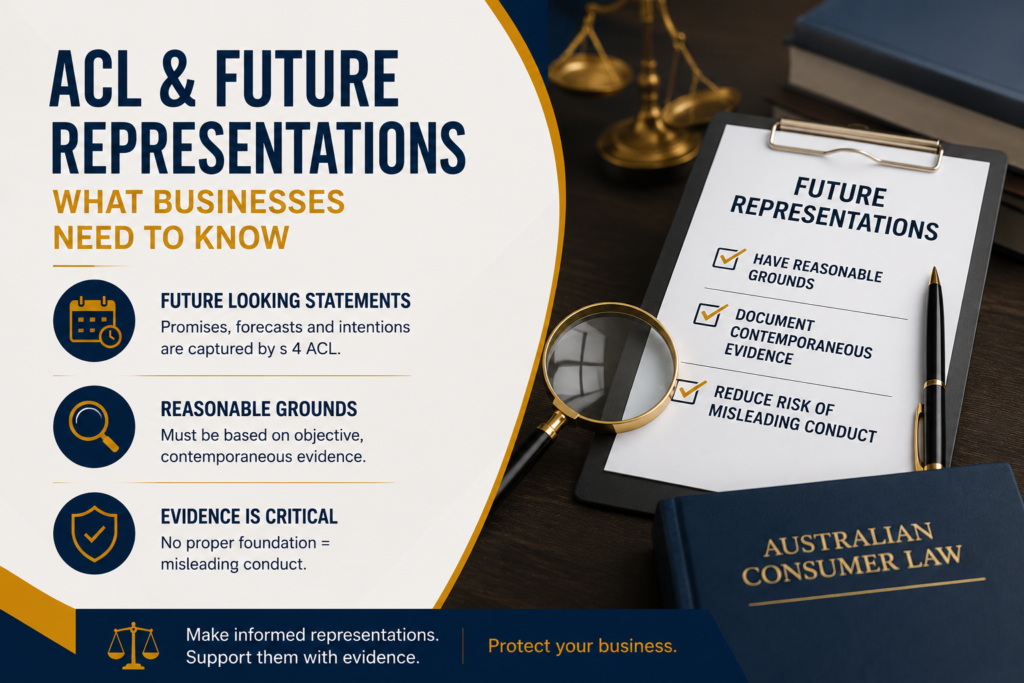
Misleading or deceptive conduct under the ACL is not confined to statements about present circumstances. Section 4 addresses representations “with respect to a future matter” and provides that a representation is taken to be misleading for the purposes of the ACL where:
- a person makes a representation with respect to a future matter (including doing, or refusing to do, an act); and
- the person does not have reasonable grounds for making the representation.
In effect, section 4 deems a future-looking representation to be misleading where it is made without a proper foundation.
Reasonable grounds
Whether there were “reasonable grounds” for making a representation about a future matter is assessed objectively and by reference to the circumstances as they existed at the time the representation was made.
In ACCC v ACM Group Limited (No 2) [2018] FCA 1115 at [173], the Court emphasised that a person will be taken to have misled by making a future representation where they lack a sufficient evidentiary basis to support it. Put another way, the representor must be able to point to facts or material capable of objectively justifying the prediction at the time it was made.
Similarly, in Delaney v Delaney [2021] VSC 365 at [452], the Court confirmed that the existence of reasonable grounds is determined at the date of the representation, not with the benefit of hindsight, and by reference to the facts available at the time.
Importantly, Storm Industries Pty Ltd (as trustee of the T&L Trust) v Unicar Australia Pty Ltd [2020] NSWDC 51 at [113] indicates that the representor’s actual belief in the prediction is not, of itself, determinative. A genuine belief will not cure the absence of an objectively reasonable basis.
In practice, “reasonable grounds” will usually depend on whether there is contemporaneous evidence supporting the prediction (for example, data, contractual arrangements, approvals, financial modelling, or other objectively verifiable material). Where a representor makes a prediction without any proper evidentiary foundation, and the prediction proves false, the representation is likely to be treated as misleading under section 4 ACL, regardless of the representor’s subjective state of mind.
Future Intention
Section 4 also has particular relevance where the “future matter” is framed as a statement about a party’s future intention. For example, “we will renew the lease”, “we will proceed with the development”, or “we will provide ongoing funding”. In these cases, the representation is not merely a prediction about external events; it is effectively an assertion about what the representor will do. As held in St George Soccer Football Association Inc v Soccer NSW Ltd [2005] NSWSC 1288 at [150], if the representation represents impliedly that the representor has a present intention to make good the promise or has the means or ability to do so, this would be indicative of an active intentional state of mind and would enliven a misrepresentation claim if their representation is not met. The practical difficulty is that intention is internal, so courts often look for objective indicators that the intention genuinely existed and was reasonably held at the time, such as contemporaneous approvals, resourcing, signed term sheets, internal instructions, or steps taken to implement the stated plan. This is especially important in negotiations, where parties sometimes use confident “deal language” to maintain momentum. Even if the statement is made in good faith, section 4 can bite if there was no proper foundation for the asserted intention. For that reason, careful drafting of correspondence and term sheets, using conditional language, clearly identifying assumptions, and avoiding unqualified commitments, can materially reduce risks.
Conclusion
At Leo Lawyers, we understand that disputes involving misleading or deceptive conduct under the Australian Consumer Law can have serious consequences for businesses and consumers alike, often requiring swift strategic legal action, particularly where liability is alleged to arise from representations, omissions, advertising or pre-contractual communications, and where loss is said to have been suffered in reliance on that conduct.
Whether you are seeking to bring or defend a claim concerning misleading or deceptive conduct, assess the availability of remedies, or consider limitation and evidentiary issues, feel free to contact Damin Murdock at Leo Lawyers via our website, on (02) 8201 0051 or at office@leolawyers.com.au. Further, if you liked this article, please subscribe to our newsletter via our website, and follow us on You Tube, Linked In, Facebook and Instagram. If you liked this article or video, please also consider leaving us a favourable Google review.
DISCLAIMER: This is not legal advice and is general information only. You should not rely upon the information contained in this article. If you require specific legal advice, please contact us.

Damin Murdock (J.D | LL.M | BACS - Finance) has over 17 years of experience as a commercial lawyer. He helps businesses navigate construction and technology law. Damin has held several big leadership roles, including serving as a director of a national law firm and the Chief Legal Officer for Lawpath.
He has personally helped more than 2,000 startups and small businesses. With over 300 five-star reviews, his clients clearly value his practical advice and simple way of explaining things. Damin has also hosted over 100 webinars that thousands of people have watched to get reliable legal help.
