
Last Updated on 29/05/2026 by Damin Murdock and Nohra Chalouhi
In recent years, the NSW Civil and Administrative Tribunal has increasingly emphasised the strict consumer protection purpose underpinning the Home Building Act 1989 (NSW) (HBA). This article explains how two recent decisions, Walsh v Archi Lab Pty Ltd [2023] NSWCATCD 67 (Walsh) and Rajagopal v Lavish Construction and Developments Pty Ltd [2025] NSWCATCD 228 (Rajagopal), demonstrate the Tribunal’s unwillingness to permit builders to benefit from non-compliance with licensing and insurance obligations, while also clarifying the narrow circumstances in which quantum meruit relief may still be available.
Homeowner and consumer protection in the HBA
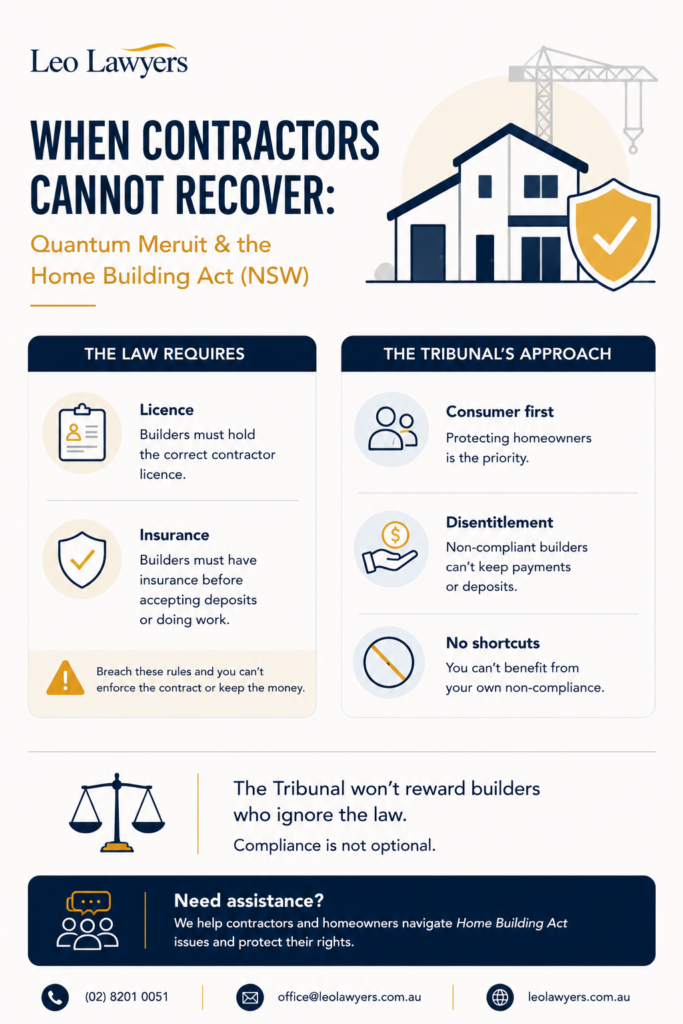
Both decisions reinforce that the licensing and insurance requirements under the HBA are not merely procedural. They are fundamental consumer safeguards designed to protect homeowners from uninsured and improperly licensed building work.
In Walsh, the builder carried out residential building work without holding the appropriate contractor licence, and the contract under which the work was to be performed failed to comply with the necessary requirements under the HBA, in breach of ss 4 and 7 respectively. The Tribunal held, pursuant to s 10 of the Act, that these breaches disentitled the builder from enforcing the contract or recovering damages for breach.
In Rajagopal, the builder accepted a substantial deposit despite no insurance being in force under s 92(2) of the HBA. The Tribunal held that the applicant was entitled to repayment of the deposit. Importantly, it approached the protective provisions in the HBA cautiously, noting that the failure to insure building work under the Act does not itself create a statutory right for the homeowner or consumer to recover money. Rather, contravention of those provisions disentitles the uninsured contractor from retaining the monies, with the applicant’s right of recovery following as a corollary.
Taken together, the cases illustrate the Tribunal’s consistent approach: a builder who disregards the statutory protections imposed by the HBA cannot expect the Tribunal to readily assist them in recovering payment.
Quantum meruit remains available — but only exceptionally
Both decisions acknowledge that a claim in quantum meruit may theoretically survive statutory non-compliance by a contractor. However, the Tribunal emphasised that this right, which qualifies a homeowner’s or consumer’s right to recover, is itself limited.
In Walsh, the Tribunal accepted that restitutionary relief may remain available despite breaches of ss 4 and 92 of the HBA. However, it noted that, because insurance was never obtained, s 94(1A) of the HBA expressly barred recovery for uninsured work unless the Tribunal considered it “just and equitable”. The Tribunal then distinguished inadvertent non-compliance from deliberate disregard of statutory obligations, citing the Supreme Court precedent in Pender v Robwenphi Pty Limited & Anor [2008] NSWSC 1144. While it accepted that the defective form of contract in breach of s 7 of the HBA may have been accidental, the builder knowingly failed to obtain insurance and to inform the owners of that fact. Consequently, the Tribunal concluded that it would not be just and equitable to permit recovery on a quantum meruit basis.
Rajagopal adopted a similar but distinct analysis. Although the builder sought to retain part of the deposit for expenses allegedly incurred for the owners’ benefit, the Tribunal held that no measurable benefit had in fact been conferred on the applicants. Consistent with restitutionary principles, a quantum meruit claim requires proof that the recipient accepted a benefit which it would be unconscionable to retain without payment. That evidentiary burden was not satisfied.
A clear message from the Tribunal
Both decisions ultimately demonstrate the Tribunal’s strong policy position that statutory protections under the HBA cannot be circumvented through restitutionary claims. While quantum meruit remains theoretically available, builders who knowingly disregard licensing and insurance requirements face significant difficulty persuading the Tribunal that equitable relief should nevertheless be granted.
Need Assistance with Uninsured Contractor Work?
At Leo Lawyers, we understand that a breach of a home building contract or a contravention of the Home Builder Act can have serious consequences for contractors and homeowners alike and requires swift legal action.
Whether you are a building contractor or homeowner, feel free to contact Damin Murdock at Leo Lawyers via our website, on (02) 8201 0051 or at office@leolawyers.com.au. Further, if you liked this article, please subscribe to our newsletter via our Website, and subscribe to our YouTube, LinkedIn, Facebook and Instagram. If you liked this article or video, please also give us a favourable Google Review.
DISCLAIMER: This is not legal advice and is general information only. You should not rely upon the information contained in this article and if you require specific legal advice, please contact us.

Damin Murdock (J.D | LL.M | BACS - Finance) has over 17 years of experience as a commercial lawyer. He helps businesses navigate construction and technology law. Damin has held several big leadership roles, including serving as a director of a national law firm and the Chief Legal Officer for Lawpath.
He has personally helped more than 2,000 startups and small businesses. With over 300 five-star reviews, his clients clearly value his practical advice and simple way of explaining things. Damin has also hosted over 100 webinars that thousands of people have watched to get reliable legal help.

