
Last Updated on 01/07/2026 by Damin Murdock
For homeowners, discovering that residential building work is uninsured can create serious legal and financial risks. Under New South Wales law, uninsured building work may affect a contractor’s right to demand payment and can significantly impact the remedies available to homeowners. Whether you are dealing with defective works, payment disputes, or concerns about home warranty insurance, it is important to understand your legal rights early. This article explains what uninsured building work means under the Home Building Act 1989 (NSW), what steps homeowners can take, and the potential consequences for contractors performing residential building works without the required insurance.
When are works required to be insured?
Any residential building works that are over the value of $20,000.00 must have home warranty insurance. This includes where there are several pieces of work at the same property by the same contractor, for instance, $5,000 for a bathroom, $10,000 for a kitchen and $7,000 for an ensuite. The purpose of home warranty insurance is to ensure that the homeowner has a remedy to recover the costs to rectify defects where the builder has disappeared, been placed into liquidation or dies.
Stop Paying the Contractor
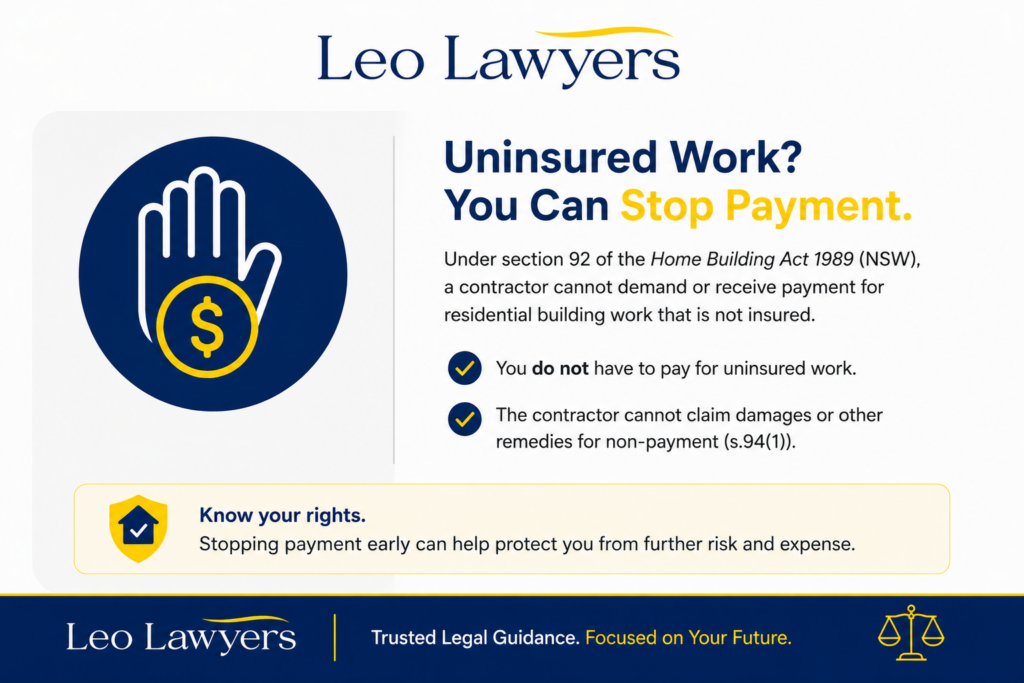
As soon as a homeowner discovers the work is uninsured, section 92 of the Home Building Act 1989 (NSW) (the Act) establishes that a contractor or builder cannot demand or receive payment from a client unless the work they are performing for that client is insured. Effectively, the contractor cannot enforce the contract against the homeowner where the works are uninsured, meaning a homeowner may ‘breach’ the contract for non-payment without fear of repercussion.
If the contractor violates the Act in such a way, section 94(1) of the Act also states that the contractor cannot claim damages or seek remedies arising from the homeowner’s breach of the contract.
Can I Recover Money Already Paid?
In Field v Dettman [2013] NSWCA 147, it was held that if all work is completed and a homeowner discovers subsequently that the work was performed by an uninsured contractor, the homeowner is not entitled to a repayment for the work already done by the contractor. Additionally, in Pender v Robwenphi Pty Ltd [2008] NSWSC 1144, it was held that the absence of insurance does not entitle a homeowner to a refund for money already paid. Therefore, it is important that issues with insurance are caught and acted upon as early as possible.
What if a Homeowner does not pay an unlicensed contractor?
If during the build, the homeowner discovers the contractors does not have insurance and decides not to pay that contractor, then the question is what happens next. In this situation, even though the contractor is uninsured, the contractor still has a right to apply to the NSW Civil and Administrative Tribunal seeking orders for the homeowner to pay for the uninsured works, however, there is a catch. In Hartley v Mc Rae [2018] NSWCATCD 31, it was held that a contractor can claim for payment if the contractor can prove that the work has been completed, and the fair value of the work has not been paid. This is in line with the doctrine of unjust enrichment. Further, in Dick v Buildingwise Constructions Pty Ltd [2023] NSWCATAP 214, it was held that for a contractor claiming an entitlement to payment for uninsured works, that contractor will be required to provide evidence of the value of works, by tendering the invoices and receipts relating to those works, and possible an expert report valuing the amount of the unlicensed works value. That is, once a homeowner does not pay a contractor of unlicensed works, the onus of proof regarding the value of the works shifts to the unlicensed contract as held in Guy v Mc Ilveen t/as K J Mc Ilveen Builders [2016].
Get in touch with our construction lawyers for all unlicensed building work disputes in NSW.
Restitution for Money Paid Under Mistake
In Field v Dettman, although it did not make a finding on this point, it suggest that a homeowner may be able to recover money already paid by a homeowner to a builder under the doctrine of restitution where the money has been paid by mistake. For instance, if the building contractor has mislead and deceived the homeowner by stating that they are insured, and the homeowner can prove that they relied upon that representation and would not have engaged the contractors if that representation was untrue, then the homeowner may be able to recover money already paid to the contractor. Even if the homeowner was able to prove this, an order for restitution will still be subject to the doctrine of unjust enrichment entitling the builder to prove the true value of the unlicensed work performed.
Need Assistance with Uninsured Contractor Work?
At Leo Lawyers, we understand that a breach of a home building contract or a contravention of the Home Builder Act can have serious consequences for contractors and homeowners alike and requires swift legal action.
Whether you are a building contractor or homeowner, feel free to contact Damin Murdock at Leo Lawyers via our website, on (02) 8201 0051 or at office@leolawyers.com.au. Further, if you liked this article, please subscribe to our newsletter via our Website, and subscribe to our YouTube, LinkedIn, Facebook and Instagram. If you liked this article or video, please also give us a favourable Google review.
DISCLAIMER: This is not legal advice and is general information only. You should not rely upon the information contained in this article and if you require specific legal advice, please contact us.

Damin Murdock (J.D | LL.M | BACS - Finance) has over 17 years of experience as a commercial lawyer. He helps businesses navigate construction and technology law. Damin has held several big leadership roles, including serving as a director of a national law firm and the Chief Legal Officer for Lawpath.
He has personally helped more than 2,000 startups and small businesses. With over 300 five-star reviews, his clients clearly value his practical advice and simple way of explaining things. Damin has also hosted over 100 webinars that thousands of people have watched to get reliable legal help.
