
Last Updated on 30/03/2026 by Damin Murdock
Under section 106 of the Strata Schemes Management Act 2015 (NSW) (the Act), Owners Corporations (OCs) have a legal obligation to maintain and repair the common property of a strata scheme. This duty is not discretionary; it is a strict statutory obligation. Failing to comply with section 106 can expose the OC to significant legal claims and financial liability.
While the core duty remains firm, legislative reforms commencing in 2025 and further compliance changes in 2026 have materially changed the risk profile for OCs and the practical rights of lot owners.
What Does Section 106 Require?
Section 106 of the Act imposes two core obligations on Owners Corporations:
-
To properly maintain and keep in a state of good and serviceable repair the common property and any personal property vested in the OC.
-
To renew or replace fixtures and fittings that form part of the common property as necessary.
This duty applies regardless of whether the damage was caused by wear and tear, weather, or other factors. The Tribunal has clarified that this does not require “perfect” outcomes; rather, the focus is on achieving the minimum standard required to ensure the property is safe, functional, and serviceable.
The “New” Section 106: Major 2025/2026 Changes
The Strata Schemes Legislation Amendment Act 2025 introduced significant reforms affecting common property maintenance disputes and the enforcement framework.
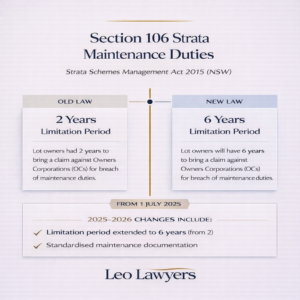
1. Limitation Period Extended to 6 Years (Commencing 1 July 2025)
A critical change is the extension of the time limit for lot owners to bring a damages claim for breach of section 106.
-
Old Position: Section 106(6) required proceedings to be commenced within 2 years after the lot owner first became aware of the loss.
-
New Position: Section 106(6) has been amended to replace “2 years” with “6 years.” This change gives owners a more realistic timeframe to identify and claim for losses related to complex or latent defects.
2. Standardised Maintenance Documentation (Commencing 1 April 2026)
From 1 April 2026, new reforms require more standardised long-term maintenance documentation to reduce “under-planning”:
-
Initial Maintenance Schedules: Developers for new schemes must provide an Initial Maintenance Schedule in a standard form.
-
10-Year Capital Works Plans: When a plan is prepared or reviewed after this date, it must utilize a standard form to ensure consistency across the industry.
Judicial Clarification: Causation and Mitigation
Recent Supreme Court authority has clarified how the strict duty interacts with damages—specifically regarding a lot owner’s behavior. In The Owners – Strata Plan No 2661 v Selkirk [2024] NSWSC 760, the Court held that an OC can contest damages if a lot owner failed to mitigate their loss.
-
Unreasonable Conduct: If a lot owner unreasonably refuses access for repairs or disrupts repair proposals, it may break the “causal connection” between the OC’s breach and the owner’s financial loss.
-
Proving the Link: To claim damages under section 106(5), an owner must prove the loss was a direct result of the failure to repair, not just that a loss occurred.
Key Responsibility-Allocation Tools
The section 106 duty operates alongside governance mechanisms that can shift responsibility in practice:
-
Common Property Memoranda: These clarify whether components (e.g., specific parts of windows or doors) are lot property or common property.
-
Section 108 By-laws: When a lot owner changes common property for their benefit, a Common Property Rights By-law usually allocates the ongoing repair obligation to that specific owner.
Remedies for Lot Owners
If an OC is in breach, lot owners commonly pursue:
-
NCAT Orders: To compel the OC to carry out work (under section 232).
-
Damages Claims: For reasonably foreseeable losses caused by the breach. The NSW Court of Appeal in Vickery v The Owners – Strata Plan No 80412 [2020] confirmed that NCAT has the power to order such damages.
Practical Next Steps
In a common property maintenance dispute:
-
Document Everything: Put requests in writing. Keep clear records of notice, inspections, and access arrangements.
-
Focus on Foreseeability: For damages claims, gather evidence early regarding the loss and how it was directly caused by the maintenance failure.
-
Watch the Clock: Be conscious of the new 6-year limitation period for seeking compensation.
If you liked this article, please subscribe to our newsletter via our Website, and subscribe to our YouTube, LinkedIn, Facebook and Instagram. If you liked this article or video, please also give us a favourable Google Review.
DISCLAIMER: This is not legal advice and is general information only. You should not rely upon the information contained in this article, and if you require specific legal advice, please contact us.

Damin Murdock (J.D | LL.M | BACS - Finance) has over 17 years of experience as a commercial lawyer. He helps businesses navigate construction and technology law. Damin has held several big leadership roles, including serving as a director of a national law firm and the Chief Legal Officer for Lawpath.
He has personally helped more than 2,000 startups and small businesses. With over 300 five-star reviews, his clients clearly value his practical advice and simple way of explaining things. Damin has also hosted over 100 webinars that thousands of people have watched to get reliable legal help.
